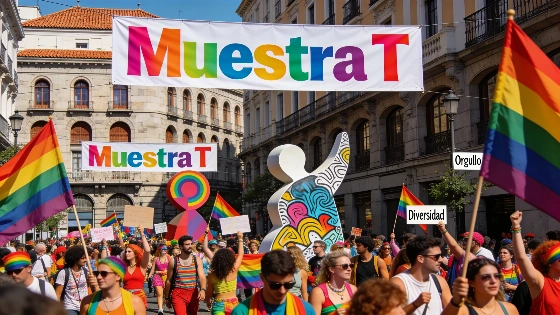
Madrid’s official LGBTQ+ arts festival, ‘Muestra T’, celebrates its 20th edition. Organisers highlight the urgent role of critical art as far-right rhetoric and policies threaten hard-won rights. This year’s focus: memory, resistance, and visibility.
Madrid’s ‘Muestra T’, the city’s official LGBTQ+ cultural festival, is marking its 20th anniversary at a time when organisers say the need for critical, activist art is more pressing than ever. As Spain faces a surge in far-right discourse and policies, the festival’s curators and artists are using exhibitions, film, and performance to defend diversity and collective memory.
Launched a year after Spain’s first same-sex marriage in 2005, ‘Muestra T’ was created to bring LGBTQ+ stories to the forefront through painting, cinema, photography, dance, theatre, and experimental art. The festival’s mission has remained constant: to unite activism and creativity, making visible the realities of gay, lesbian, bisexual, and transgender people in the capital. Organisers stress that art has long served as a vehicle for expressing what could not be openly said, especially in times of repression.
This year’s edition is shaped by a sense of urgency. The festival’s theme, echoing activist Pedro Zerolo’s call for “orgullo ciudadano” (citizen pride), responds directly to what organisers describe as a rollback of civil rights and the spread of exclusionary, extremist narratives. Juan Carlos Alonso, general coordinator of MADO (Madrid Pride), says the creative process itself is now a form of resistance, especially as political forces attempt to erase or rewrite LGBTQ+ history.
One of the festival’s core aims is to engage younger generations with the community’s past, ensuring that the names and stories of those who fought for rights are not forgotten. Cecilia Montagut, an Argentine filmmaker and member of the festival’s board, warns that as older generations disappear, younger people who did not experience repression firsthand are more vulnerable to manipulation. She points to recent far-right victories in Latin America and the rise of parties like Vox in Spain, which have led to the closure of equality offices and open hostility toward cultural initiatives.
Montagut’s documentary ‘Memoria y sexualidad de las mujeres bajo el franquismo’, screening on July 17, explores the repression of lesbian and bisexual women during the Franco dictatorship. She sees the festival as a bridge between academic research and the general public, aiming to break down initial prejudices and encourage broader understanding through art.
Visual artist Felipe Rivas, whose exhibition ‘Un archivo inexistente’ uses artificial intelligence to reconstruct lost moments of queer intimacy in Latin America, argues that art’s power to imagine alternative realities is especially vital as governments cut cultural funding. He notes that the lack of archival material on sexual dissidence, particularly among working-class Latin Americans, has left many stories untold or distorted by mainstream narratives.
In 2024, Argentina’s government announced severe cuts to its national film and arts institute, while in Spain, Vox’s entry into over 140 local governments led to the elimination of many equality departments. Rivas believes that in this climate, critical art is not just relevant but essential for emancipation and visibility.
The festival’s programme this year is its most ambitious yet, featuring more than 15 exhibitions across Madrid and nearby towns like Chinchón and Aranjuez, an online gallery for national and international artists, film screenings, electronic music sessions, and workshops. Special attention is given to lesbian and trans visibility, with projects like ‘Muéstrate con ellas’—a platform for works by women artists—growing significantly over the past two decades. Montagut will also present ‘Cárceles Bolleras’, a documentary on discrimination and resistance among lesbian inmates.
Festival activities coordinator Natacha Nazer describes ‘Muestra T’ as both a showcase for emerging talent and a tool for social awareness, especially in the face of anti-LGBTQ+ policies. The festival’s longevity, she says, reflects both public interest and the ongoing need for spaces that foster diversity and challenge dominant narratives.
For many involved, the existence of a permanent, recognisable LGBTQ+ space in Madrid is crucial. Montagut notes that without such venues, the visibility of women’s demands in particular risks being diluted or perceived as threatening. Alonso, reflecting on two decades of ‘Muestra T’, sees the festival as a living record of what the community has been, achieved, and aspires to become.
Madrid’s cultural and political landscape has seen significant shifts in recent years, with new platforms and movements emerging to challenge the status quo. For example, the launch of Independientes por Madrid, led by Marta Higueras, has added to the city’s dynamic political scene, as reported in coverage of Madrid’s evolving political landscape. Against this backdrop, ‘Muestra T’ continues to serve as a focal point for artistic resistance and community solidarity.
Spain remains one of Europe’s most prominent countries for LGBTQ+ rights, having legalised same-sex marriage in 2005 and hosting one of the world’s largest Pride celebrations. However, the current political climate has introduced new uncertainties. The ongoing debate over cultural funding, the visibility of minority groups, and the preservation of historical memory underscores the importance of events like ‘Muestra T’. As the festival enters its third decade, its organisers and participants are determined to keep art at the centre of the struggle for equality and recognition.