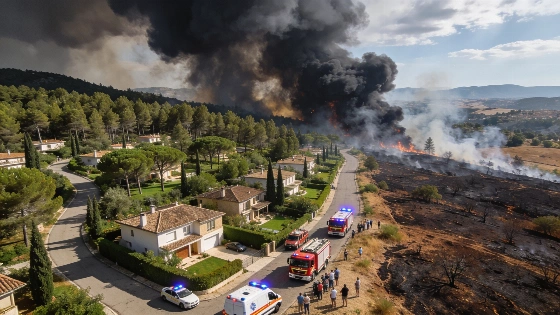
Recent wildfires in Madrid’s southwest have heightened fears in affluent suburbs like Boadilla del Monte. Local authorities and residents are on alert, as nearby evacuations highlight the vulnerability of forested residential areas.
Wildfires sweeping through the southwest of Madrid have put affluent municipalities such as Boadilla del Monte, Villanueva de la Cañada, and Villaviciosa de Odón on high alert. While these areas narrowly avoided direct impact this time, the proximity of the flames and recent evacuations in nearby towns have intensified concerns about future risks. Residents and local officials acknowledge that the threat of fire is now a pressing reality for communities known for their forested residential developments.
On Saturday morning, Boadilla del Monte showed signs of returning to normal, with clear skies and residents back at local cafés. However, just a day earlier, shifting winds had brought the fire dangerously close, prompting anxiety among locals and authorities. The mayor, Javier Úbeda, confirmed that the situation was tense until weather conditions improved. The fire, which devastated rural villages on the region’s periphery, could have easily reached the densely populated and prosperous suburbs if conditions had changed.
These municipalities, often described as “urbanizaciones bosque” for their integration with natural woodland, are particularly exposed to wildfire hazards. Residents in areas like Urbanización El Bosque in Villaviciosa de Odón reported following the news closely as friends in affected towns faced evacuation. Although panic did not spread in Boadilla, the episode left many uneasy, with some describing the area as a “frontier” against advancing fires.
Boadilla del Monte, Spain’s second wealthiest municipality, has long attracted those seeking a balance between urban amenities and natural surroundings. The town boasts nearly 2,000 hectares of public and private woodland, making fire prevention a top priority each summer. While major incidents have been avoided in recent years, smaller fires—such as a recent blaze that started in ornamental hedges—have served as reminders of the ongoing risk. Last summer, a fatal fire in Tres Cantos, another Madrid suburb, underscored the potential consequences when wildfires reach urban areas.
Local authorities have implemented a range of preventive measures. Boadilla employs grazing sheep to reduce dry grass between December and June, minimizing potential fuel for fires. During the summer, a dedicated forest fire brigade is stationed in the area, and a surveillance drone has recently been added to monitor for both fires and missing persons. The opposition PSOE party acknowledges the municipality’s efforts but argues that declaring the entire woodland area as public utility would provide stronger protection and more resources, transferring responsibility to the regional government and shielding the land from speculative development.
Rapid response is considered essential in these communities. Some, like La Finca in Pozuelo de Alarcón, benefit from nearby fire stations. Residents are also urged to maintain their gardens, especially the fast-burning hedges that often surround properties. Local councils have introduced fines for neglecting garden maintenance, a common issue in homes that are not permanently occupied. In La Cabaña, another Pozuelo neighborhood, residents have organized patrols to deter arson attempts in the adjacent Montegancedo woodland, which remains the last significant green space in the area. Ongoing legal disputes between developers and environmental groups have further complicated the management of these vulnerable zones.
Spain’s geography and climate make it particularly susceptible to wildfires, especially during increasingly hot and dry summers. According to official data, the country experiences thousands of forest fires annually, with the majority occurring between June and September. Urban expansion into forested areas has heightened the risk for residential communities, prompting authorities to invest in prevention, early detection, and public awareness campaigns. The situation in Madrid’s western suburbs reflects a broader national challenge: balancing the desire for natural living environments with the realities of a changing climate and the persistent threat of wildfire.