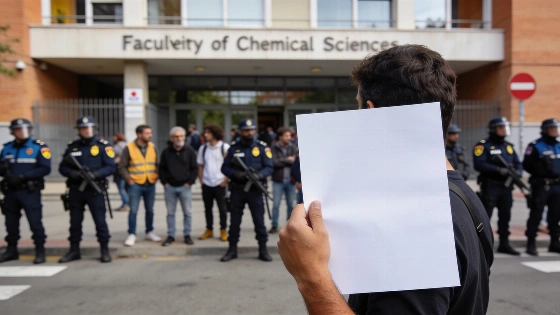
Thousands of teachers gathered outside Madrid’s education department on Thursday as the open-ended strike entered its second day. CC OO reported 60% participation, against 32% from the regional government. CSIF put turnout at 45%.
In the regional parliament, Isabel Díaz Ayuso accused the left of turning violent when it expects to lose elections. Protests continued across the Community of Madrid.
Thousands of teachers gathered outside the Consejería de Educación on Calle Alcalá on Thursday, 15 October. It was the second day of the indefinite strike, which began on 14 October. The walkout was called for around 65,000 teachers serving more than 666,000 students across the region. Comisiones Obreras, or CC OO, put participation at 60%; the regional government reported 32%. Other reports cited 62% for the unions and 32.2% for the education department. Both figures in the original estimates fell from Wednesday: CC OO’s by 10 percentage points and the government’s by 12.
Other counts diverged further. EFE cited sources from the unions calling the strike who put participation at 72%. On the first day, unions gave an overall estimate of 70% to 75%, while the regional government reported 44.6%. CSIF called a separate strike outside the joint action and reported 45%, equivalent to nearly 31,000 teachers according to El Confidencial.
CC OO and UGT made the joint call, alongside STEM and CGT. CNT and Solidaridad Obrera also helped organise the strike. The gap between estimates partly reflects different counting methods, including how staff assigned to minimum services are treated. Madrid set minimum staffing at one teacher per 50 pupils in primary schools and one per 90 students in secondary schools. Special-education centres must have one teacher per 15 pupils. The turnout dispute was already a central issue on the first day, as an earlier report on the walkout showed.
UGT education representative Javier Becerra said participation had remained at 100% for a second consecutive day in several schools, after accounting for minimum service staffing. He named public schools Antonio Moreno Rosales in Madrid’s Centro district and Trabenco in Leganés.
In early-years centres serving children under three, minimum staffing is one educator per 12 children under one year old. The ratio is one per 18 children under two and one per 24 children under three. Each centre must also have a director.
Teachers marched from Calle Alcalá to plaza de Colón. From there, they turned towards Cibeles under a large police deployment. Many wore green shirts associated with the pre-university strike launched this week. Yellow shirts marked the stoppage by early-years educators, which began half a year ago. A group of teachers also tried to block the Castellana.
The unions are seeking a €600 monthly pay rise for education workers at every level. They want class sizes capped at 23 students in Bachillerato and 20 in compulsory secondary education. Their proposed limits are 15 in primary school and 13 in the second cycle of early-years education.
They are also calling for reduced teaching workloads and less bureaucracy. Other demands include more staff, funding for vocational training and special education, and a new climate-adaptation plan for schools. The regional government has called some demands unattainable and says it has held regular negotiations with worker representatives.
Some demonstrators from Rivas-Vaciamadrid said they planned to keep striking for as long as their savings allowed. Leticia, a special-education teacher from Fuenlabrada, described a lack of a dedicated curriculum and suitable facilities. She said pupils’ profiles were changing substantially. Citizens and passengers on packed buses showed support during the protest.
Addressing the regional parliament, Ayuso said left-wing movements turn violent when they expect to lose elections and reject democratic rules. She was referring to mobilisations across the region in recent weeks, including the teachers’ strike. Education minister Mercedes Zarzalejo called the strike political and electoral. She said the region would ensure students’ right to education and teachers’ right to work.