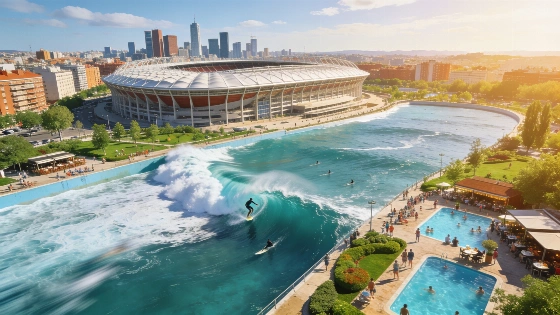
Construction of Gemswell Surf Madrid, a €60 million surf and leisure destination next to the Riyadh Air Metropolitano, is 40% complete. The project will feature Europe’s largest artificial wave lagoon and is on track to complete construction by February 2027. A two-month testing phase will follow before the complex opens to the public in spring. Telemadrid reported on 22 October 2026 that construction was advancing, while Vida de Madrid also reported the spring 2027 opening target. Once operational, the complex expects to attract around 500,000 visitors annually and deliver approximately 180,000 hours of surfing each year.
Central to the development is a 23,000-square-metre artificial lagoon, roughly the size of two football pitches, designed to offer a range of wave experiences. The lagoon, 181 metres wide and up to 2.9 metres deep, will hold nearly 30,000 cubic metres of water. It is divided into two basic areas: Bahía, for beginners, and Reef, for advanced surfers. Up to 120 people can take part in each hourly session. Wavegarden technology will generate a new wave every eight seconds, with more than 20 wave types reaching heights of up to two metres. Telemadrid and Vida de Madrid have also reported the lagoon’s area and use of Wavegarden technology. A dedicated surf academy will offer lessons for children as young as four, alongside advanced training programmes.
Beyond Surfing
Gemswell Surf Madrid is planned as a sports facility with a broader leisure offering. The basic building will span two floors and 6,000 square metres, with a social club and gym, plus Pilates and yoga studios. It will also house two saunas, a contrast pool and changing rooms. Four additional pools, including two 25-metre lanes, will complement the basic lagoon; Telemadrid and Vida de Madrid also describe four infinity pools. The venue is designed to accommodate up to 2,850 guests at a time and will feature a surfskate area and concert spaces, as well as a specialist surf shop and parking for around 860 vehicles. Plans also include approximately 5,000 square metres of sand, alongside multipurpose spaces for activities such as yoga.
The culinary offering will cover more than 3,000 square metres across five restaurants, ranging from family-friendly to youth-oriented concepts. Some venues will be accessible independently of the sports area and open from breakfast through dinner.
Economic Impact and Backers
The €60 million investment is led by Atlético de Madrid and Stoneweg InfraSports, a partnership between Stoneweg and Teras Capital. The surf complex forms part of the wider Ciudad del Deporte development associated with the stadium. Financing includes a syndicated loan from Santander and BBVA, alongside €15.7 million in European funds. The project is expected to create between 180 and 200 jobs, with projected annual revenues of €20 million. Vida de Madrid has separately reported expectations of more than 100 jobs and approximately 500,000 annual visitors.
Sustainability Debate
Water use has sparked debate among environmental groups. The lagoon will initially be filled through the Canal de Isabel II network and maintained with a filtration and recirculation system. A stormwater reservoir is planned to recover up to 7,000 cubic metres of water annually. The Plataforma Ecologista Madrileña has called for a halt to construction, citing estimated annual evaporation losses of 32,200 cubic metres and total consumption of between 38,000 and 42,000 cubic metres. Project promoters point to the site’s “Very Good” BREEAM sustainability rating and plans for extensive landscaping, including shaded areas.
Madrid’s growing appeal as a leisure and tourism hub is also reflected in recent regional developments. These include the arrival of Royal Caribbean’s flagship cruise liner in Málaga, which showcased the city’s capacity for large-scale tourism infrastructure. For more on this trend, see the coverage of the cruise ship’s debut here.