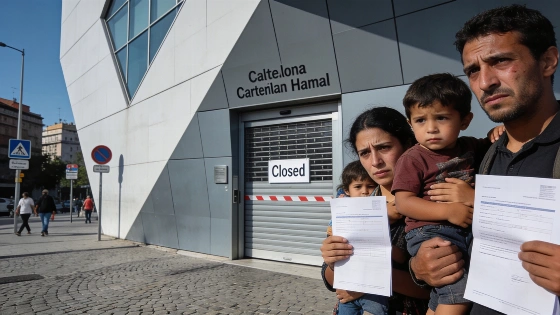
A new report reveals that over 60% of Catalonia’s largest cities hinder access to municipal registration. Vulnerable groups, especially migrants, face the most obstacles. The findings raise concerns about public service planning.
More than half of Catalonia’s largest municipalities are failing to ensure effective access to the municipal register, according to a new report from Entidades Catalanas de Acción Social (ECAS). The study, based on a survey conducted with Ksnet, found that 40 out of the 60 most populous cities in the region present significant barriers to registration, with 29 municipalities—10 of them in the Barcelona Metropolitan Area—not registering all applicants. The issue is particularly acute for migrants and people in irregular administrative situations, who make up the majority of those affected.
ECAS director Carlos Macías emphasized that these obstacles are neither isolated incidents nor the result of a single administration. The report, prompted by a journalist’s inquiry into the current state of the registration process, draws on qualitative input from 54 social organizations, ombuds offices, and neighborhood platforms that support vulnerable residents. The findings highlight that the registration process is often undermined by inconsistent practices and additional requirements not stipulated by law.
The report details how people facing severe housing exclusion encounter the greatest difficulties. Among the cases documented, 80% involve migrants and 70% concern individuals without regular administrative status. The main problems identified include differential treatment based on housing type, origin, income level, and residential status. The registration process itself is broken down into four stages—document preparation, application submission, technical verification, and case resolution—with issues reported at every step, especially for those without stable housing or legal residency.
Access to appointments and the cost of securing them have also emerged as barriers in some municipalities. In addition, some local authorities demand extra documentation not required by national regulations, further complicating the process for those already at risk of exclusion. The municipalities analyzed in the report account for around 62% of Catalonia’s population, including major cities such as Barcelona, L’Hospitalet de Llobregat, Badalona, Sabadell, Terrassa, Girona, Santa Coloma de Gramenet, and Vilafranca del Penedès. The problem, according to the authors, is widespread and not limited to cities governed by any particular political party.
Elena Costas, a partner at Ksnet, noted that while suspicions exist, the issue is not directly linked to right-wing administrations. She described the situation as a structural problem, with many municipalities failing to register people in vulnerable situations regardless of political leadership. Social organizations and advocacy groups had already raised alarms about these obstacles during the 2023 municipal elections, and the latest survey confirms that the difficulties persist. Costas also stressed that the problem is not confined to small towns.
The municipal register is a critical tool for planning public health, allocating school places, and organizing public services. When the registration system fails, it undermines both the quality of democratic governance and public trust in institutions. Costas concluded that the reliability of registration data is essential for a diverse, democratic, and anti-racist Catalonia.
These findings echo broader regional tensions over residency and access to services. For example, recent disputes over transport card funding and residency rules between Catalonia and Madrid have highlighted the practical impact of administrative barriers on daily life, as seen in the recent standoff over public transport funding.
In Spain, municipal registration (empadronamiento) is a legal requirement for all residents and serves as the basis for access to healthcare, education, and social services. The process is intended to be universal and non-discriminatory, but in practice, local variations and administrative hurdles can leave the most vulnerable without essential rights. The ongoing challenges in Catalonia underscore the importance of consistent application of national regulations and the need for oversight to ensure equal treatment for all residents, regardless of their origin or housing situation.