Castilla y León faces another record wildfire under Alfonso Fernández Mañueco. Firefighters highlight ongoing resource issues. The president’s subdued approach contrasts with national calls for urgent action.
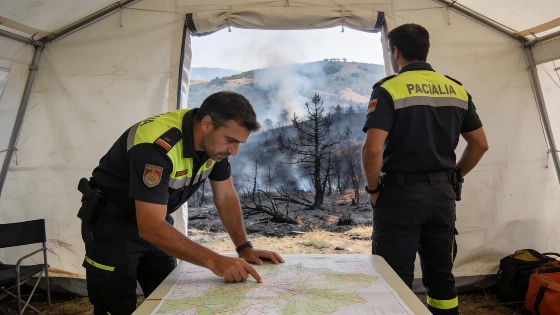
Castilla y León is once again at the center of Spain’s wildfire crisis, with the latest blaze in Burgohondo (Ávila) scorching around 50,000 hectares. This disaster adds to a series of record-setting fires that have struck the region in recent years, all during the tenure of Alfonso Fernández Mañueco. Despite the scale of destruction and repeated criticism from emergency services over inadequate resources, Mañueco has maintained a notably subdued public presence throughout the emergency.
While the national spotlight has shifted to Madrid’s president Isabel Díaz Ayuso and Prime Minister Pedro Sánchez—especially after Sánchez declared a national emergency for Madrid’s fires—Mañueco has refrained from requesting similar support for Castilla y León. Instead, he has focused on local measures, including financial aid for those displaced and affected by the fires. This week, he announced €500 payments for evacuees and €5,500 grants for impacted business owners, farmers, and ranchers, echoing relief efforts from previous years.
The region’s fire management has undergone changes, with the controversial Juan Carlos Suárez-Quiñones replaced by María González Corral as environment councillor. However, the new leadership has avoided public disputes, and the operational challenges remain. Firefighters and brigadistas continue to report insufficient training, unstable employment, and poor coordination, despite a significant increase in funding—from €64 million in 2022 to nearly double that amount now. One firefighter described the system as wasteful and lacking real improvements.
Political tensions have intensified as opposition leader Carlos Martínez (PSOE) criticized the Junta’s handling of the crisis and called for a national climate pact, a proposal previously dismissed by the PP. Martínez also urged Mañueco to seek state support, as Ayuso did for Madrid. The coalition government of PP and Vox has delegated wildfire responsibilities to a newly created Directorate-General for Forest Fire Prevention and Extinction, but critics argue that the region’s fire response remains under-resourced and reactive.
During the current emergency, Mañueco has made regular visits to the command post in Navaluenga, providing updates based on technical briefings. He has emphasized that authorities will support those who have lost everything, but his public appearances have been limited compared to previous crises. In past years, Mañueco’s communication shifted from defending the region’s fire response to requesting more national aid and attributing the fires to extreme weather conditions. His earlier remarks, such as calling year-round fire operations “absurd and wasteful,” continue to draw criticism.
Political analysts, like Alicia Gil-Torres from the University of Valladolid, note that a regional president’s leadership is most scrutinized during crises. Mañueco’s low visibility stands in contrast to the heated national debate, but experts suggest that unless the opposition can build a compelling narrative of political responsibility, the long-term electoral impact may be limited. The persistence of wildfires in Castilla y León has become a recurring issue, with the region repeatedly breaking records for burned area and fatalities.
Spain has faced a series of devastating wildfires in recent years, with climate change and land management practices contributing to the increased frequency and severity of these events. The situation in Castilla y León mirrors challenges seen elsewhere in the country, such as the destruction experienced by the village of Casavieja, which narrowly avoided total loss during Spain’s largest wildfire, as detailed in this report on the aftermath in Ávila and surrounding provinces. Nationally, debates continue over the adequacy of prevention strategies, the allocation of resources, and the need for coordinated action across regional and central governments. As wildfires become more frequent and intense, the effectiveness of political leadership and emergency response remains under close scrutiny.