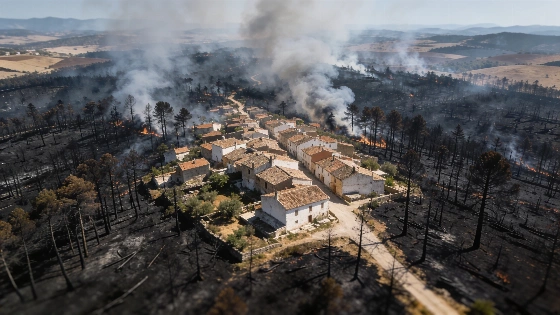
Casavieja narrowly escaped destruction as Spain’s largest wildfire burned over 77,000 hectares across Ávila, Toledo, and Madrid. The village’s urban center remains, but its surrounding forests and livelihoods have been devastated.
Casavieja, a small village in Ávila, has become an isolated patch of green amid the aftermath of Spain’s largest recorded wildfire. While the urban center was spared, the surrounding forests have been reduced to blackened remnants, leaving residents facing the loss of both landscape and livelihood. The fire, which has already consumed more than 77,000 hectares across Ávila, Toledo, and Madrid, advanced rapidly, reaching the outskirts of Casavieja in less than six hours and forcing a tense standoff with the flames.
For locals like Isabel Jiménez, who managed thousands of pine trees for resin extraction, the destruction is personal and economic. The municipality had allocated pine groves to a handful of resin workers, but now, every tree she worked with has been lost. Jiménez describes the forest not just as a workplace, but as a vital part of her life and identity. The emotional toll is compounded by the uncertainty of recovery, as it takes decades for pines to reach the size needed for resin collection. She doubts the forest will return to its former state within her lifetime, though she holds out hope that nature will eventually reclaim the area.
The devastation extends beyond the resin industry. The Fuente Helecha campsite, once a popular local destination, now resembles a disaster zone. Burned-out bungalows and melted bicycles stand as stark reminders of the fire’s intensity. Pilar Andrada, a forest firefighter and resident, stayed behind during the evacuation to help protect the village. She recalls how the fire surrounded Casavieja, with residents risking their safety to defend homes and farmland built over decades of effort.
Elsewhere, the process of returning to normality has begun. In Toledo province, all 13 evacuated villages have been allowed to return. In Castillo de Bayuela, dairy farmer Montserrat Sánchez chose to remain with her 400 cows despite evacuation orders, citing the impossibility of abandoning her animals. She criticized the lack of veterinary and medical support during the crisis and argued that a full lockdown would have been more appropriate for the community’s needs.
Some evacuees, like Marta Gutiérrez, found temporary refuge in Talavera de la Reina’s sports hall, where volunteers provided food and care for both people and pets. Vulnerable residents, including the elderly, were relocated to more suitable accommodations. The scale of the emergency response was significant, with around 1,800 people sheltered in Talavera alone.
Local authorities faced challenges in communication and logistics. Gregorio García, mayor of Castillo de Bayuela, noted that the municipality learned of the evacuation through Infocam’s social media. The town used loudspeakers, mobile alerts, and WhatsApp to inform residents, which led to heightened anxiety. Special permits were arranged to allow farmers limited access to care for livestock during the lockdown period.
As the smoke clears, the immediate danger has passed, but the scars on the landscape and community remain. The experience in Casavieja echoes the broader impact of wildfires across Spain, where rural economies and ways of life are increasingly threatened by extreme events. The dismantling of barriers, such as the recent removal of the Gibraltar border fence after decades of division, as reported in coverage of cross-border changes, highlights how communities across Spain are adapting to both natural and political upheavals.
Wildfires have become a recurring challenge in Spain, particularly in regions with extensive pine forests and dry summers. The economic impact extends beyond immediate property loss, affecting agriculture, tourism, and traditional industries like resin extraction. Recovery is often slow, with reforestation and soil restoration taking years or even decades. Authorities continue to review emergency protocols and support measures for affected communities, aiming to balance safety with the practical needs of rural residents. The situation in Casavieja serves as a stark reminder of the vulnerability of Spain’s rural heartland to environmental disasters and the resilience required to rebuild.