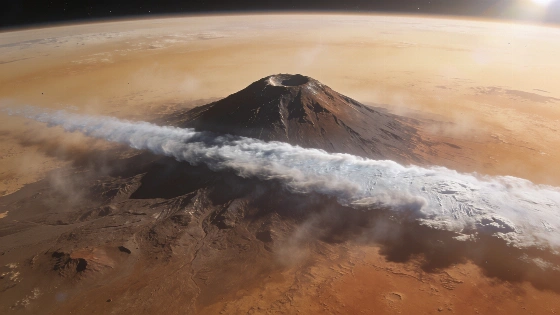
Each spring, a 1,800-kilometre cloud appears above Arsia Mons. Researchers say it forms without dust or other particles, forcing a rethink of how clouds develop on Mars.
In September 2018, Jorge Hernández Bernal noticed a shadow in images from the European Space Agency's Mars Express probe. Researchers later identified it as a cloud that returns each day during the Martian spring.
The cloud stretches about 1,800 kilometres and reaches roughly 150 kilometres in width beside Arsia Mons. A study in Nature Geoscience, titled Homogeneous Ice Nucleation from Water Vapour Suggested by Elongated Clouds on Mars, says the cloud forms through homogeneous nucleation. The process does not need suspended dust or other impurities. The paper was written by Jorge Hernández-Bernal, Annika Määttänen, Aymeric Spiga and François Forget. Its DOI is 10.1038/s41561-026-02089-9.
The researchers compared Mars Express observations with meteorological modelling. Their work does not measure homogeneous nucleation directly inside the cloud. Instead, the conclusion comes from the model results. A scheme based only on ordinary heterogeneous nucleation could not reproduce the cloud's observed structure.
The modelled air had to reach an extreme state of supersaturation: one independent analysis puts the required level at more than 100,000 times higher than conditions typically encountered on Earth.
That finding helps explain why the mechanism was considered highly unlikely on Mars. The planet has low atmospheric humidity and airborne dust, conditions expected to make direct ice formation difficult. According to an independent analysis of the study, the air had to become more than 100,000 times as supersaturated as conditions usually found on Earth.
Mars Express's Visual Monitoring Camera showed that the feature was not a passing shadow or a brief visual artefact. Its regular appearance identified it as a seasonal event and gave researchers a way to study the atmosphere around Arsia Mons.
The physical explanation starts with the volcano's height and the air moving around it. Winds pass over Arsia Mons and create a gravity wave. That wave lifts moist air several kilometres within a few minutes.
As the air rises, it cools fast. The study records a temperature drop of about 30 degrees Celsius in 10 minutes, followed by a sharp rise in relative humidity. Water vapour can then freeze directly into ice particles without first turning into liquid.
The Arsia Mons cloud is not produced by volcanic eruptions. Arsia Mons is an ancient volcano about 20 kilometres high, while the cloud consists of water ice created when atmospheric flow is forced over the terrain.
This is homogeneous nucleation. In the more familiar process, water droplets or ice form around dust and other particles. Here, no foreign surface acts as the trigger. The Martian atmosphere and the abrupt lift above Arsia Mons create the conditions needed for a process not previously observed in a real planetary atmosphere.
Ricardo Hueso, director of the Planetary Sciences Group at UPV/EHU, says the result overturns established assumptions about Martian clouds. In his assessment, clouds on Mars can behave very differently from clouds on Earth.
Meteorologist José Miguel Viñas links the process to the forced rise and rapid cooling of air above the volcano. The study's authors call the result the first evidence of homogeneous water-vapour nucleation in a planetary atmosphere.
Daniel Toledo of INTA points to the finding's wider scientific value. Events at the molecular scale shape the cloud's enormous size and reach. A microscopic change in how water freezes helps create a formation that spans 1,800 kilometres of the Martian sky.
The study does not establish how often homogeneous nucleation occurs elsewhere on Mars or how much it affects the planet's water cycle. It does show that low humidity and dust do not rule out the process when the terrain creates a sharp atmospheric change.
According to the modelling, the long tail of the cloud could not be reproduced without homogeneous nucleation. The conventional heterogeneous-nucleation model fell short, while the updated scheme matched the observed features from Mars Express. That result could force climate models of Mars to revise their cloud microphysics.
Arsia Mons offers a natural setting for studying the link between volcanic relief, atmospheric motion and cloud formation. The same result could also inform research on clouds on Earth and other planets.
The cloud follows a strict daily cycle. It appears around local morning, grows for roughly three hours and disappears several hours later. The pattern repeats for about 80 days or longer during the relevant Martian season, giving researchers a regular test case for cloud microphysics.
The cloud's size is only part of the story. Mars can produce a familiar-looking ice cloud through a molecular route that differs from the usual Earth-based expectation. The findings also suggest that models of clouds on Mars, Earth and other planets may need to account for homogeneous nucleation.