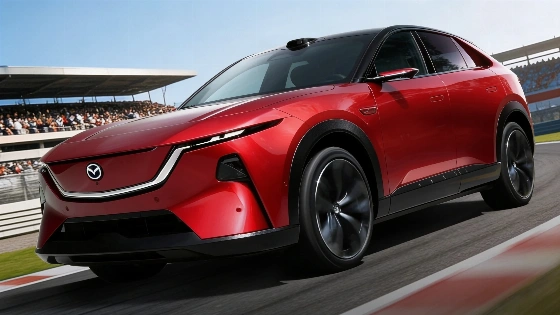
Mazda’s CX-6e lands in China with LiDAR-assisted driving and both electric and range-extended versions. Its price is nearly half that of the Tesla Model Y, raising tough questions for Europe’s EV market.
Mazda’s new CX-6e hit the Chinese market with a jolt. The surprise wasn’t just the tech. It was the price. The SUV comes with a roof-mounted LiDAR system for advanced assisted driving. The starting price is 145,900 yuan—about 18,967 euros. That’s less than half what a Tesla Model Y costs in China.
Chinese buyers get options. The CX-6e, also called EZ-60, comes as a pure electric or a range-extended (EREV) model. The electric version uses a 77.94 kWh LFP battery from CALB. It can go up to 600 kilometers on the CLTC cycle, or 474–486 km WLTP. The EREV combines a 1.5-liter gasoline generator with a 31.73 kWh battery. That setup gives 200 kilometers of electric-only range and a total range well over 1,000 kilometers. Both versions use a 190 kW rear motor and can hit 185 km/h. Fast charging from 30% to 80% takes just 15 minutes. Quick and simple.
The official Chinese price range for the updated Mazda EZ-60 spans from 119,900 to 172,900 yuan, with launch prices temporarily set even lower—from 113,900 to 166,900 yuan.
LiDAR is the big upgrade here. The CX-6e’s “L2 advanced” assisted driving can handle more than 200 scenarios. It manages highway lane changes at up to 130 km/h, and it can deal with city intersections and roundabouts at speeds up to 80 km/h. The system uses three millimeter-wave radars, 12 ultrasonic sensors, 11 cameras, and the new laser scanner. Trims with LiDAR cost 12,000 yuan (1,560 euros) more than standard versions. Electric models cost 6,000 yuan (780 euros) more than EREV.
The LiDAR lineup is priced to move. EREV Pro 200 km LiDAR is 145,900 yuan (18,967 euros). EREV Max 200 km LiDAR is 160,900 yuan (20,917 euros). EV Pro 600 km LiDAR is 151,900 yuan (19,747 euros). EV Max 600 km LiDAR is 166,900 yuan (21,697 euros). The cheapest electric CX-6e without LiDAR starts at 139,900 yuan (18,187 euros). For comparison, the Tesla Model Y in China starts at 263,500 yuan (34,255 euros). The full CX-6e range sits between 113,900 and 166,900 yuan (14,807–21,697 euros). The gap is huge. In the UK, the launch price is 42,990 pounds—almost three times the Chinese price.
August 2026 sales data shows Mazda delivered 4,532 CX-6e units in China. That’s 45% of Mazda’s local sales. The CX-6e rides on Changan’s EPA1 platform and shares much with the Deepal S07. This points to a bigger trend: Japanese and Chinese automakers are teaming up. The CX-6e is Mazda’s second China-developed model with Changan, after the Mazda6e (EZ-6). Both are now sold in Europe.
The LiDAR system in the EZ-60 uses a Hesai ATX sensor on the roof, working in tandem with three millimeter-wave radars, 11 cameras, and 12 ultrasonic sensors. According to Teslant, the LiDAR can detect objects up to 200 meters away, with a forward perception zone exceeding 250 meters.
Europe is a different story. The CX-6e that arrived in Spain this summer is basically the same as the Chinese electric version. But it costs much more. There’s no range-extended option. No LiDAR system—at least not yet. The specs and WLTP range are almost the same, but the lack of EREV and advanced radar shows the gap in value and tech between the two markets. Charging numbers can’t be compared directly, since Mazda uses different measurement intervals in Europe.
China’s low prices and fast rollout of new features are changing the game. As reported earlier, Chinese brands are using their home advantage to challenge established players abroad. Mazda’s partnership with Changan is a clear sign of this shift.
The CX-6e’s arrival in Europe—missing its best features and carrying a much higher price—shows how far apart the markets have grown. Chinese buyers get more for less. European buyers pay more and get less. For now, the CX-6e’s Chinese launch sets a new standard for value and tech in mid-size SUVs. It puts real pressure on European importers to explain their prices and missing features. Unless Europe adapts, the gap will only grow. Local buyers are left asking why innovation and low prices stop at the border.