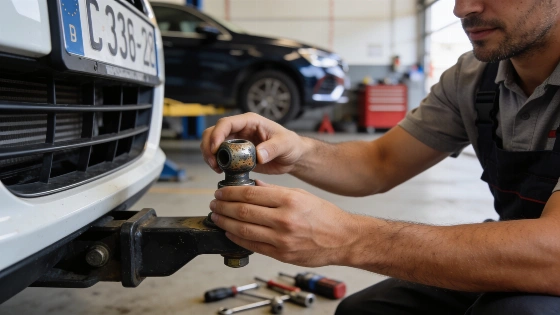
Greasing a car’s tow ball might seem like routine maintenance, but mechanic Juan José Ebenezer says it can actually make your trailer less safe. His advice challenges a widespread habit among Spanish drivers.
Many drivers reach for grease or spray to make a rusty tow ball look better, but mechanic Juan José Ebenezer says this is a mistake that can lead to real safety problems. Ebenezer, who has a large following on TikTok, warns that lubricating the tow ball isn’t just unnecessary—it can actually make your trailer’s brakes less effective.
It’s a common belief that a shiny, smooth tow ball means you’re taking good care of your car. Ebenezer disagrees. The friction material (ferodo) used in trailer stabilizers needs direct contact with the tow ball to keep the trailer steady and prevent it from swinging or jackknifing. If you add grease or spray, you lose that friction, and the stabilizer can’t do its job. “Never, never, never put grease or spray, or anything strange, on the tow ball,” Ebenezer says in one of his TikTok videos.
Industry guidelines distinguish between standard towing balls and those used with friction stabilizers: while grease can reduce wear on a regular ball, it is strictly prohibited for stabilizer systems with friction pads, as it undermines their safety function.
Independent technical review
Instead of covering up scratches or rust with lubricants, Ebenezer suggests using a simple cap to keep moisture off the tow ball when you’re not towing. He says that visible wear is actually a sign that the stabilizer is working as it should. “If you lose the paint, it’s because the brake is working,” he explains. The real danger isn’t a bit of rust—it’s losing the friction that keeps your trailer under control.
Ebenezer also points out that many drivers load their trailers incorrectly. Putting most of the weight at the back makes the trailer unstable. The safest way is to keep the heaviest items close to the car or at least in the center, never at the rear. “Always load more from the middle forward, so the car stays stable and can recover grip quickly if there’s a swerve,” he says. Ignoring this can lead to jackknifing or even a rollover, which are real risks on Spanish roads.
Electrical connections are another source of confusion. Newer cars often have thirteen-pin connectors, while many trailers still use the older seven-pin type. Ebenezer says there’s no need to rewire anything—just use an adapter. “Just use an adapter, you don’t need to change any plugs,” he says, making the process less intimidating for drivers.
In European towing setups, using a 13-pin to 7-pin adapter only provides basic lighting functions; advanced features like reverse lights and auxiliary power will not work if the trailer or vehicle is limited to 7-pin wiring. This is a common source of confusion for owners expecting full functionality from a simple adapter.
Technical industry analysis
Ebenezer’s straightforward advice stands out in a world where bad information spreads quickly online. His direct style has earned him a large audience, many of whom trust him for both technical tips and personal advice. As reported earlier, his openness about his own struggles has only made him more credible among Spanish drivers.
According to Google/SpainAuto, the problem isn’t just about individual habits—it’s about a general lack of understanding of how modern towing systems work. The ferodo-based stabilizers on many European trailers are designed for dry friction, not lubricated surfaces. Greasing the tow ball might seem harmless, but it can quietly disable a key safety feature. With more people in Spain using trailers and caravans, Ebenezer’s warning is a timely reminder: sometimes, the safest thing you can do is leave the tow ball alone.