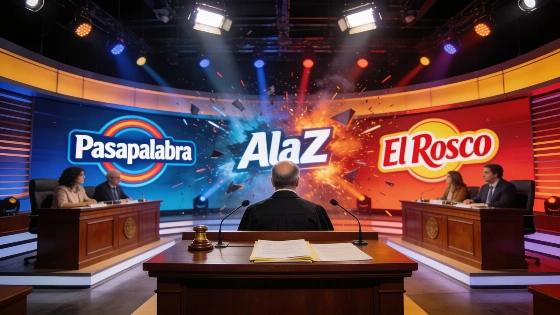
Mediaset has announced immediate legal action against Atresmedia over 'AlaZ'. The Dutch company MC&F claims the new final round in 'Pasapalabra' is too similar to 'El Rosco'. The case could impact Spanish TV programming.
A new legal battle has erupted in Spanish television after Mediaset, acting on behalf of the Dutch rights holder MC&F, announced a lawsuit against Atresmedia. The dispute centers on 'AlaZ', the recently introduced final round in 'Pasapalabra', which MC&F alleges is nearly identical to the iconic 'El Rosco' format. According to Mediaset, the company will seek immediate legal measures to halt the broadcast of 'AlaZ', citing both plagiarism and unfair competition.
The controversy follows a Supreme Court ruling that previously forced Atresmedia to remove 'El Rosco' from its programming, as the network did not own the rights. Now, MC&F, which holds those rights and has sold them to Mediaset for future use, argues that 'AlaZ' retains too many elements of the original. The company points to similarities in the structure, gameplay, and visual presentation, despite minor changes in graphics and the arrangement of letters on screen.
Atresmedia has so far declined to comment on the pending lawsuit, maintaining silence when approached by media outlets. 'AlaZ', which has been airing since June 19, places contestants inside a blue and orange arch, with the host reading definitions linked to alphabet letters. Unlike 'El Rosco', the letters now appear in a row at the bottom of the screen, and contestants choose whether to answer from A to Z or in reverse. However, MC&F maintains that these adjustments do not sufficiently differentiate the new format from the original.
The original Swiss format, acquired by Atresmedia and ITV, features a single contestant in a booth, a ten-minute time limit, and a system where hints reduce the prize money rather than the time. In contrast, the Spanish adaptation keeps multiple contestants, a cumulative jackpot, and a shared screen, all of which MC&F claims are hallmarks of 'El Rosco'. Mediaset also notes that, unlike the Swiss version, 'AlaZ' allows for celebrity participation and extended gameplay across episodes.
The legal process could have significant implications for Spanish television, as 'Pasapalabra' remains a ratings leader on Antena 3. The outcome will determine whether Atresmedia can continue airing 'AlaZ' or must once again alter its flagship game show. Meanwhile, Mediaset has not disclosed details about its own plans for the format, which it intends to relaunch in the upcoming season.
For context, 'El Rosco' was a staple of Spanish TV for 26 years, first on Antena 3 and later on Telecinco, until legal disputes over format rights forced its removal. When Telecinco lost 'Pasapalabra' in 2019, it attempted to fill the gap with 'El Tirón', but the new show failed to capture the same audience. The ongoing legal wrangling highlights the complexities of intellectual property in television formats, especially when minor changes may not be enough to avoid claims of infringement. The Spanish Supreme Court has previously emphasized that unique elements such as contestant arrangement, time limits, and graphic design contribute to a show's distinctiveness, setting a precedent for the current case.