Mercedes-Benz dates its papal-car history to 1930, when Daimler-Benz AG gave Pío XI a Nürburg 460. The Vatican Museums opened the exhibition on 28 October 2026, marking nearly a century of cooperation between Mercedes-Benz and the Holy See. León XIV attended the opening and met Mercedes-Benz executives; visitors could see the exhibition from the following day.
Titled “A century of Popemobiles”, the display brings together eight Mercedes-Benz vehicles associated with papal use, from the Nürburg 460 to the 300 d Landaulet, 600 Pullman-Landaulet, 300 SEL Pullman limousine, 230 G, S 500 long-wheelbase Landaulet, ML 430 and ML 500. The exhibition also includes a Benz Patent Motor Car, the first automobile ever built, and a modern Clase S. One Clase S carries the number 140, referring to the years Mercedes-Benz has been making cars. RUSSPAIN's coverage of Geely's market entry examines a separate development in Spain.
The 1930 Nürburg 460 had a 4.6-litre eight-cylinder engine beneath its saloon body. Its interior was modified to meet Pío XI's requirements, including an individual seat upholstered in silk brocade. The cabin also featured special wood and an artistically designed ceiling. This car starts the exhibition’s chronology, which moves from formal papal limousines to vehicles designed to let the Pope greet and bless worshippers at public appearances.
Mercedes-Benz's papal vehicles from the 1960s included the 300 d Landaulet, delivered in 1960. Its longer wheelbase and removable rear side windows suited public appearances; steps unfolded automatically when the rear doors opened. Pablo VI received a 600 Pullman Landaulet in autumn 1965, with wider rear doors and a raised roof section. It also had a small refrigerator and an intercom linking the rear compartment to the driver.
Pablo VI mainly used the 300 SEL Pullman to transport senior Vatican guests. It was 650 millimetres longer than the standard model and had six seats.
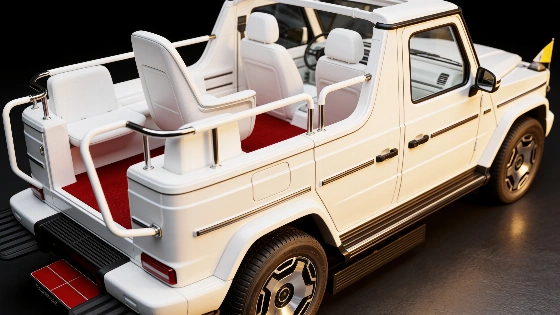
For Juan Pablo II's visit to Germany, Mercedes-Benz developed a Clase G papal vehicle. A 230 G was used in 1980, followed by a 230 GE in 1982. The long-wheelbase vehicle had a transparent dome to shield the Pope from cold and rain, along with pearlescent paint and a white interior. Later vehicles based on the G-Class and M-Class continued the move toward designs that kept the Pope visible to crowds.
A long-wheelbase Clase S 500 followed in 1997, fitted with an electrohydraulic roof and a spacious individual rear seat. In 2002, Juan Pablo II first used a Clase ML 430 at World Youth Day in Toronto. Its transparent dome blended into the custom body, which had pearlescent paint and a white interior.
The Vatican received an ML 500 in December 2012 for Benedicto XVI. Its enlarged transparent rear section made access easier. Larger glass panels improved visibility, and the cabin gained updated lighting. Mercedes-Benz also used an electric G as a Popemobile.
The exhibition is on view in a glass pavilion near the Vatican Pinacoteca through 31 January 2027. In remarks reported by Vatican News, León XIV linked automotive advances to the significance of papal journeys and said technological new idea should serve human dignity. He also described the Popemobile as an instrument of encounter.