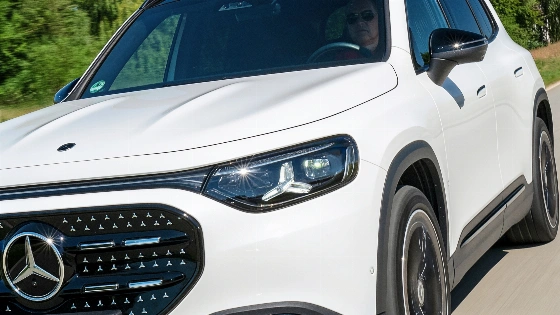
Mercedes brings the GLB 250 Plus with sharp looks, smart tech, and a roomy cabin. Its electric drive and fast charging make it one of the most usable and enjoyable SUVs out there.
The Mercedes GLB 250 Plus shows what an electric SUV can really do. This new model drops the old EQB name. Only the rear badge gives away that it runs on electricity. Everything about it feels made for daily use, not just for the showroom.
Step inside and the boxy shape pays off. There is plenty of headroom and width for both rows. The rear bench now has a bit less thigh support than before, which you notice on long trips. You can still order a third row, but the test car did not have it. The boot is big—540 to 1,715 litres—making it one of the most useful in its class. Independent European tests confirm the flat floor and easy loading height, which help with daily chores.
The GLB 250 Plus is built on an 800-volt electrical architecture, enabling faster charging and improved efficiency compared to previous Mercedes EVs.
Tech is front and center in the GLB. Three separate screens stretch across the dash, borrowed from the CLA. You get a smart voice assistant powered by AI and sharp Google maps for navigation. The screens are bright but sit a bit lower than ideal. The passenger can watch videos while driving, but if the driver looks over, the system stops playback right away.
The GLB 250 Plus stands out when you drive it. Power goes to the rear wheels—272 horsepower and 335 Nm of torque—through a two-speed gearbox on the rear axle. The gearbox shifts at about 120 km/h to save energy, but you barely notice it. Strong energy recovery lets you drive with one pedal all the way to a stop. Auto Zeitung measured 0–100 km/h in about 7.4 seconds, with a top speed of 210 km/h. That puts the GLB among the faster electric SUVs in its class.
Charging is another strong point. The GLB 250 Plus can take up to 350 kW DC. It charges from 10 to 80 percent in just 22 minutes. These numbers match or even beat what Mercedes claims. If you want faster AC charging at home or work, you can upgrade from 11 to 22 kW. In real use, the car averaged 18.9 kWh per 100 km. That is about 20 percent higher than the official figure, but still good for a car this size and power.
There are discrepancies in reported DC fast-charging rates for the GLB 250 Plus: some sources cite a maximum of 320 kW, while others list 350 kW, depending on market and configuration. This variation is important for buyers comparing charging infrastructure and real-world usability.
On the road, the GLB feels nimble for its size. The front wheels turn sharply, so the car has a tight turning circle. The chassis has two firmness settings. Even the softer one is firmer than you might expect from a Mercedes. Driver aids work well, keeping the car in its lane and reacting quickly in emergencies. But the steering can feel vague when the systems are active.
Not everything hits the mark. The massage function in the front seats, for example, just moves the lumbar support in a way that feels random, not relaxing. Still, these small issues do not take away from the sense that this is a practical, well-made electric SUV.
While carmakers argue over in-car tech—like the recent US House vote to require AM radio in all new cars, as reported earlier—Mercedes has focused on digital features that actually make driving better, without making things too complicated.
The GLB 250 Plus proves that electric SUVs can be fun and useful. There are no big trade-offs at the charging station or on the highway. With its space, fast charging, and smart connectivity, it sets a new bar for the segment. The price is premium, but for buyers who want a daily driver ready for the future, the value is clear. Mercedes has built an electric SUV that quietly raises the standard for everyone else.