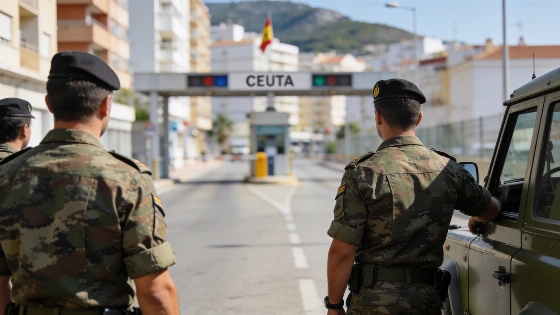
Three military associations have complained to Spain's ombudsman over the treatment of troops serving in Ceuta. They are demanding clearer operational information, protection for personal data and safeguards against physical and health risks.
Three military associations have taken the situation of troops deployed in Ceuta to the Ombudsman. Their complaint covers the information soldiers receive, the protection of their personal data and safeguards against physical and health risks. It puts the legal and personal conditions of the deployment alongside the immediate demands of the crisis.
ASFASPRO, AUME and UMT want personnel to receive the functional information they are legally entitled to use in carrying out their duties. The associations say troops who have spent days helping the population maintain normal activity need clearer guarantees about their legal position and personal safety.
On 17 September, two soldiers deployed in Ceuta were evacuated to Madrid’s Gómez Ulla hospital after sustaining injuries in reported assaults by migrants.
Their demands also include measures to prevent possible physical attacks and contact with diseases.
The three organisations have another concern: the identifying data of military personnel. They say those details must be protected so they cannot be used to locate soldiers, their relatives or people close to them. For the associations, data protection is part of the security system around the operation in the autonomous city. It is not an administrative afterthought.
On 21 September, Interior Minister Fernando Grande-Marlaska confirmed a preventive reinforcement of Ceuta and Melilla, with three reserve and security-group units of the Civil Guard assigned to each autonomous city. The decision reflects the wider border-security pressure surrounding the deployment.
The complaint is directed at the Ministry of Defence and its head, Margarita Robles. ASFASPRO, AUME and UMT say the Armed Forces have faced a series of demanding deployments in recent years. They point to the pandemic, the La Palma volcano, the DANA, wildfires and border operations. The Ceuta crisis has added to that burden. The associations describe an institution carrying out repeated interventions while its available personnel are declining.
They also connect the immediate concerns in Ceuta to a longer staffing problem. The associations say military careers have become less attractive to young people because of working and financial conditions. In their view, unfilled vacancies could make it harder to provide enough personnel for future operations. Spanish media, citing the associations, reported that repeated mobilisations have increased concerns about recruitment, retention and the sustainability of the current operational model.
As reported by RUSSPAIN in its coverage of the Ceuta border, the city has already been treated as a security-sensitive setting. Reports also described a large influx of people from Morocco at the end of July. The security presence in Ceuta was reinforced afterward. The organisations' complaint adds another question: what conditions are soldiers expected to work under while carrying out the deployment?
The financial figures show the scale of the response. Ceuta has allocated 309 million euros across reception, security and essential services. That includes 74 million euros for the Defence Ministry and the armed forces. The allocation shows the logistical and institutional costs of maintaining the operation. It does not resolve the associations' concerns about personnel protection or legal certainty.
The facts presented by ASFASPRO, AUME and UMT point to a gap in the system. A deployment cannot be judged only by its public purpose when operational information, personal safety, health prevention and data protection remain unresolved. The Ombudsman complaint is a warning about the cost of relying on a shrinking force for a growing list of missions.
The Ministry of Defence and the Ombudsman may now be expected to address the requested safeguards. These include clearer orders, proportionate use-of-force guidance, medical-risk prevention and protection for service members' personal information.
According to reporting by Europa Press and statements attributed to the Interior Ministry, the additional security measures were presented as preventive steps amid concern about further border crossings. The next stage will depend on the institutional response to the associations' complaint. It will also depend on whether operational, medical and legal protocols for troops in Ceuta are clarified.