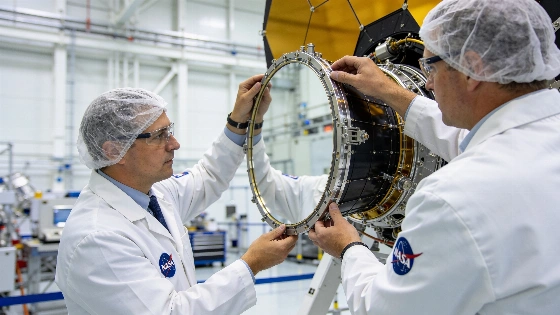
NASA prepares to launch the Nancy Grace Roman Space Telescope. The mission will create the most detailed map of dark matter yet. Its findings could challenge the foundations of modern physics.
The Nancy Grace Roman Space Telescope is about to take on one of astronomy’s biggest questions: what is dark matter, really? Roman’s instruments will scan huge sections of the sky, looking for the faint distortions that hint at this invisible material. The hope is that the mission’s results could force scientists to rethink some of the basic rules of physics.
Dark matter isn’t something we can see or touch. Its presence is known only because its gravity bends the light from distant galaxies. Roman will use this effect—gravitational lensing—to map where dark matter collects and how its structures have changed over time. By measuring tiny shifts in the images of hundreds of millions of galaxies, the telescope will build the most detailed map yet of dark matter’s distribution. NASA reports that the Roman telescope’s Wide Field Instrument, a 300-megapixel infrared camera, was successfully tested in September 2026, an important step before launch.
NASA has confirmed that Roman's fuel reserves will allow it to operate for at least 22 years, more than double the original 10-year estimate.
Alejandro Rivera, who has worked at NASA for 26 years on projects like Roman, says the mission is the result of decades of research and technical progress. While dark matter itself remains out of reach, its gravitational effects are clear. Rivera compares the effect to looking through old, wavy glass: the distortions reveal something you can’t see directly. Roman’s data will not only map dark matter but also test how gravity and dark energy interact—two forces that shape the universe. An independent review by AZoQuantum notes that Roman’s wide-field surveys will chart the positions, shapes, and distances of hundreds of millions of galaxies across about one-sixth of the sky, giving cosmologists a huge new dataset.
Roman’s work isn’t limited to mapping. The telescope will also test Einstein’s general relativity on the largest scales ever attempted. It will measure both how fast the universe is expanding and how quickly cosmic structures grow. If these numbers match, Einstein’s theory holds up. If not, scientists may need to rethink how gravity works. Rivera calls this the most intriguing part of the mission. NASA’s science blog says Roman’s data will be key for measuring both the universe’s expansion and the growth of structure, which is essential for testing general relativity on cosmic scales.
For anyone interested in space science, Rivera points out that missions like Roman need people from many backgrounds. Physics, math, and aerospace engineering are important, but so are programming, electronics, materials science, robotics, and even biology and medicine. The main thing, he says, is a strong base in math and physics, plus real interest in your chosen field.
Roman will use weak gravitational lensing as a primary method to trace dark matter, analyzing the shapes of distant galaxies to reveal how matter is distributed and how cosmic structures have evolved over time. This approach is central to the mission's goal of testing the standard model of cosmology.
AZoQuantum
Roman’s launch comes at a time when astronomers are working together more than ever. Its findings will add to data from the European Euclid mission, the Extremely Large Telescope, and the Vera Rubin Observatory in Chile. There is some competition—China is building its own wide-field space telescope—but the main focus is on sharing discoveries. As Rivera puts it, astronomical data ultimately benefits everyone.
Dark matter is thought to be five times more common than ordinary matter, making everything we see—stars, planets, people—a small part of the universe. The terms “dark matter” and “dark energy” are placeholders for things science can’t yet explain, similar to the “ether” once used in physics. But unlike past ideas that faded away, the evidence for dark matter and dark energy is strong and persistent. Roman’s mission is to turn that mystery into something measurable, pushing the limits of what we know and possibly changing the rules that describe the universe.
As the Nancy Grace Roman Space Telescope gets ready for launch, scientists are preparing for results that could reshape cosmology. If Roman’s data supports Einstein’s predictions, it will strengthen the foundation of modern physics. If not, it could open the way to new theories and discoveries. Either way, the mission’s findings will influence how we understand the universe and guide the future of space science and technology.