NASA has powered up a cutting-edge instrument on the Nancy Grace Roman Space Telescope, designed to block starlight and reveal faint exoplanets. The device, now entering months of calibration, could change how astronomers detect distant worlds and debris disks.
NASA has switched on a new technology that could change how we search for exoplanets. The Coronagraph Instrument aboard the Nancy Grace Roman Space Telescope is now active, a key step toward photographing planets that have been hidden in the glare of their stars.
This coronagraph is built to block starlight so effectively that it can reveal objects up to 100 million times dimmer than the stars they orbit. The Jet Propulsion Laboratory, which leads the project, says this leap in sensitivity could outperform current space coronagraphs by a factor of 100 to 1,000. NASA calls the Roman coronagraph the most advanced ever flown in space, aiming to directly image planets much fainter than their host stars and to test new technologies for future missions.
The Roman coronagraph is a key technological step toward the future Habitable Worlds Observatory, which aims to directly image Earth-like planets.
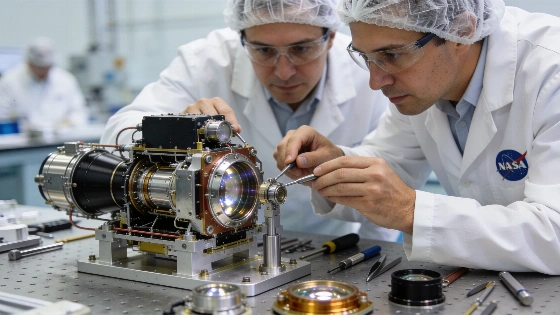
At the core of the system are deformable mirrors and precision masks—hardware that can adjust to correct optical flaws and scatter. The idea is simple: block the star, see what’s next to it. In practice, it’s difficult. Planets like Jupiter reflect only a tiny fraction of their star’s light and are easily lost from millions of kilometers away. NASA and JPL note that the instrument's optics, masks, and deformable mirrors are designed to suppress starlight and correct for distortions, something not achieved at this level in space before.
The activation, completed between 7:27 and 8:22 a.m. Eastern Time on September 1, 2026, is just the start. The instrument now enters a long phase of calibration and testing, as teams work to stabilize the system and fine-tune its ability to block starlight. Only after these months of adjustments will the coronagraph begin its planned three months of scientific observations, spread over the first 18 months of the mission. NASA says this phased approach is needed to confirm the instrument's performance before collecting scientific data.
Roman’s coronagraph is not meant to find another Earth—at least not yet. Its main targets are older, colder gas giants and the dusty disks that often surround stars. The goal is to capture visible-light images of planets similar in size and temperature to Jupiter, orbiting close to their stars—worlds that have so far escaped direct observation. NASA materials note that the coronagraph's observing time is limited and focused on these bright but faint-in-contrast targets, not on a broad survey of exoplanets.
The Roman mission, originally known as WFIRST, was conceived as a flagship observatory for dark energy, exoplanets, and infrared astrophysics. Its coronagraph is a technology demonstration, not a dedicated planet-hunting tool, with scientific observations scheduled only during the early phase of the mission.
NASA is clear: this is a technology demonstration, not a full-scale planet-hunting campaign. The main scientific instrument on the observatory is the Wide Field Instrument, but the coronagraph’s success could lead to future missions, including the planned Habitable Worlds Observatory, which aims to study Earth-like planets around Sun-like stars. NASA says the Roman coronagraph is directly tied to advancing the technologies needed for such future observatories.
The telescope itself is still on its way to its operational post. Launched on August 30, 2026, atop a Falcon Heavy rocket, the Nancy Grace Roman Space Telescope is now traveling a three-month journey to the Sun-Earth L2 Lagrange point, 1.5 million kilometers from Earth. During this trip, engineers are deploying, activating, and calibrating every system on board. The coronagraph’s activation is a milestone, but not the start of the main science campaign. NASA expects the first images from the coronagraph by early 2027, after extensive system checks and calibrations.
Roman’s field of view will be much larger than that of the Hubble Space Telescope, allowing it to measure the light of up to a billion galaxies during its mission. Its work goes far beyond exoplanets, with plans to study dark matter, dark energy, and the structure of the universe. NASA describes the Roman telescope as a major step forward in wide-field infrared astronomy and cosmology.
The coronagraph’s first images are still months away, but its successful activation shows the hardware is powered and responsive. The real test will come when it tries to separate the faint glow of a planet from the bright light of its star—a challenge that, if met, will set a new standard for direct imaging in space.
As the Roman telescope continues its journey, astronomers are watching closely. If the coronagraph works as planned, it will not only prove a new generation of optical technology but also open the door to missions that could find and study worlds that have been invisible until now. For those following space exploration, this moment joins other recent advances in astronomical detection, showing how quickly the field is moving.
NASA’s decision to invest in a high-risk, high-reward technology demonstration is a clear bet: steady progress in optics and engineering could lead to discoveries that change our understanding of the universe. The Roman coronagraph’s activation is not a promise of immediate results, but it shows NASA’s willingness to push boundaries and accept the uncertainty that comes with real innovation.