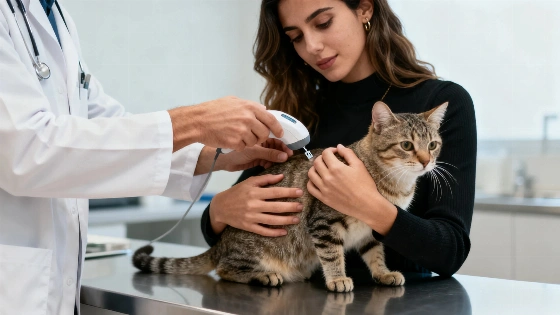
Cat Owners in Spain Face Heavy Fines for Lack of Microchip. Since 2023, Spain has required all cats to be identified with a microchip. Owners who fail to comply with this law risk fines of up to 200,000 euros. We explain what has changed and why it matters.
Since the beginning of 2023, a new requirement has come into force for cat owners in Spain: animal identification with a microchip is now not just a recommendation, but a strict obligation. Law 7/2023 on animal welfare introduced unified rules across the country and increased liability for violations.
Previously, mandatory microchipping mostly applied to dogs and depended on the region, but now the law also covers cats. Under the new rules, the microchip must be implanted by a licensed veterinarian, and information about the animal and its owner must be entered into an official registry. The chip itself is a miniature device implanted under the skin in the neck area and contains a unique code that allows for the quick identification of the owner if the pet is lost.
What the law says
According to Article 51, all pets must be individually identified through a system approved for their species. For cats, this means mandatory microchip implantation and registration of data. If the animal is lost, a veterinary clinic, shelter, or police can scan the code and contact the owner.
Fines and risks
Ignoring the new rules can prove very costly. Failure to microchip is punishable by fines ranging from €10,000 to €50,000, and in particularly severe cases — up to €200,000. The law emphasizes that without identification, an animal falls outside official oversight, making it harder to locate and protect. According to statistics, only 4.3% of cats brought into shelters are chipped — the rest remain anonymous and risk not returning home.
Owners' responsibilities
In addition to microchipping, owners must maintain their pet's health and hygiene, prevent uncontrolled breeding, ensure compulsory veterinary procedures are followed, and, if required, undergo training in responsible pet ownership. For cats, there is a separate requirement: both microchipping and sterilization must be completed by the age of six months, unless the animal is registered as a breeding cat.
Practical implications
For many families, this means making sure their pet complies with the new requirements. If your pet is not microchipped, visiting the vet should not be delayed. Otherwise, you may face not only the risk of losing your animal but also serious financial penalties.
The issue of pet identification is becoming increasingly relevant against the background of other changes in Spain's social policy. For example, the government has recently launched a large-scale support program for young families buying homes — you can learn more about this in the article about new subsidies for real estate buyers.
Overall, the new rules on cat microchipping are not just a formality, but a real tool to protect animals and their owners. The law aims to reduce the number of abandoned and lost pets, as well as to make it easier for them to return home.