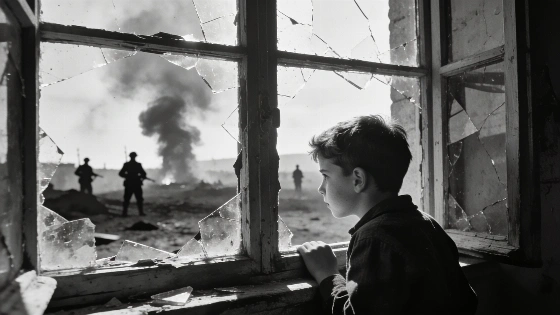
Nicolás Sánchez-Albornoz, now 100, recalls how the Spanish Civil War forced his family into exile. His story highlights the long shadow of conflict, political persecution, and the struggle for memory in Spain.
On the 90th anniversary of the 1936 coup that ignited the Spanish Civil War, the testimony of Nicolás Sánchez-Albornoz, who recently turned 100, brings into focus the enduring impact of conflict on Spanish families. His childhood in Madrid was abruptly shattered when machine-gun fire from the assault on the Cuartel de la Montaña reached his home near Plaza de España. Forced to flee, his family joined thousands of others who scattered across Europe to escape violence and repression.
The Sánchez-Albornoz family’s ordeal began on July 18, 1936, when plans to reunite in Lisbon were derailed by illness and the rapid advance of the war. Claudio Sánchez-Albornoz, a historian and former minister, had just been appointed ambassador to Portugal. The family’s journey to safety was complicated by shifting frontlines and closed borders, eventually leading them from Madrid to Alicante, then by ship to Portugal, and later into exile in France. In Lisbon, Claudio faced death threats from fascist sympathizers, while Portugal’s government openly supported the Francoist uprising, expelling him months later.
Exile in France brought new challenges. As the war ended and Franco’s regime consolidated power, the Sánchez-Albornoz family witnessed the arrival of Spanish refugees and the collapse of hopes for a quick return. The Nazi occupation of France added further danger, with Francoist authorities sending lists of Republican exiles to the Gestapo. Claudio narrowly avoided arrest thanks to a timely warning, but others, like Lluís Companys and Julián Zugazagoitia, were not as fortunate. The family was forced to separate again, with Claudio eventually reaching Argentina after a complex journey through Marseille, Algiers, Casablanca, and Rio de Janeiro.
Back in Spain, the consequences of defeat were severe. The family’s property was confiscated by the Tribunal de Responsabilidades Políticas, and purges swept through institutions like the University of Madrid, where nearly half the staff were dismissed. Nicolás, whose father had been rector, found himself under suspicion and joined the clandestine Federación Universitaria Escolar (FUE), which resisted the regime’s control over academic life. A symbolic act of defiance—a silver nitrate slogan for a free university—remained visible on the faculty building for years, a silent protest against repression.
Repression soon became personal. After the FUE leadership was arrested, Nicolás was detained and sentenced to six years in prison by a military court. He was transferred to the Valle de los Caídos, forced to work on Franco’s mausoleum, before escaping in a dramatic flight that would later inspire the film Los años bárbaros. His father, still in Argentina, lobbied for his release, but it was only after the escape that Nicolás regained his freedom, reuniting with his family years later.
The legacy of the Civil War and dictatorship continues to shape Spain’s political landscape. As the country marks this anniversary, debates over historical memory remain contentious. The Partido Popular has renewed its pledge to repeal the Law of Historical Memory, while Vox, its coalition partner in several regions, openly challenges the characterization of the dictatorship as a dark period. These disputes echo the unresolved wounds described by Sánchez-Albornoz, whose memoirs argue that confronting the past is essential to healing a divided society.
Spain’s struggle with its history is not unique. Across Europe, the legacy of 20th-century conflicts continues to influence politics, identity, and public debate. The experience of families like the Sánchez-Albornoz—marked by exile, loss, and resilience—offers a reminder of the personal costs behind historical events. For those interested in how tradition and conflict intersect in Spanish society, the annual San Fermín festival in Pamplona, with its own history of risk and controversy, provides another lens on the country’s complex relationship with its past, as seen in the recent report on the Jandilla bull run.
Understanding the trajectory of Nicolás Sánchez-Albornoz and his family helps illuminate the broader consequences of Spain’s 20th-century upheavals. The ongoing debates over memory laws and the interpretation of the Civil War underscore how the past remains a battleground in Spanish public life. As Spain continues to grapple with these issues, the stories of those who lived through the conflict serve as a vital record and a call for reflection.