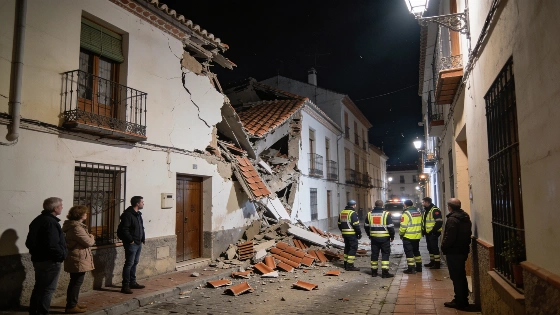
A 4.8-magnitude earthquake struck Granada overnight, damaging buildings and prompting emergency measures. Over 80 emergency calls were reported. Authorities urge caution as aftershocks continue.
A powerful earthquake shook Granada in the early hours of Saturday, causing structural damage and prompting the Junta de Andalucía to activate emergency protocols. The tremor, measured at 4.8 on the Richter scale, had its epicenter in Alhendín and was recorded at 1:04 a.m. at a depth of 10 kilometers, according to the Instituto Geográfico Nacional (IGN). Residents across much of Andalusia felt the quake, with emergency services receiving more than 80 calls in the immediate aftermath.
Reports of falling debris, damaged facades, and roof tiles came in from multiple locations in the Granada metropolitan area, including Armilla. The 112 emergency service confirmed that calls were received from nearly every province in Andalusia except Huelva and Cádiz. The authorities responded by declaring operational emergency level 1 under the regional seismic risk plan, a move announced by Antonio Sanz, the regional minister for Presidency, Health, and Emergencies. Residents were advised to remain calm, avoid entering or leaving buildings, and stay clear of facades, balconies, and walls due to the risk of further collapses.
The IGN noted that the quake was widely felt not only in Granada and its suburbs but also in northern towns like Huéscar, coastal areas such as Almuñécar, Salobreña, and Motril, and further afield in Jaén, Almería, Málaga, and Córdoba. The tremor's effects reached as far as Puertollano, Ciudad Real, Albacete, and even Madrid, though with less intensity. Six minutes after the main event, a smaller 2.6-magnitude quake was recorded in Gójar, just a kilometer deep. Three additional minor tremors had already been detected in the Granada area on Friday, keeping residents on alert.
Spain's emergency response to natural disasters has been tested repeatedly in recent years, with authorities emphasizing preparedness and rapid communication. For example, severe weather events have also led to widespread alerts and disruptions, as seen when intense storms and hail prompted orange alerts across northern and eastern Spain. The current seismic episode in Granada highlights the ongoing need for robust emergency planning in regions prone to natural hazards.
Earthquakes of this magnitude are relatively rare in mainland Spain but not unprecedented, especially in southern regions where tectonic activity is more pronounced. The IGN continuously monitors seismic activity, and local authorities regularly update safety protocols. Residents are reminded to follow official guidance during and after such incidents, as aftershocks can occur and damaged structures may pose ongoing risks. The rapid response and communication from emergency services in Granada demonstrate the importance of coordinated action when natural events disrupt daily life.