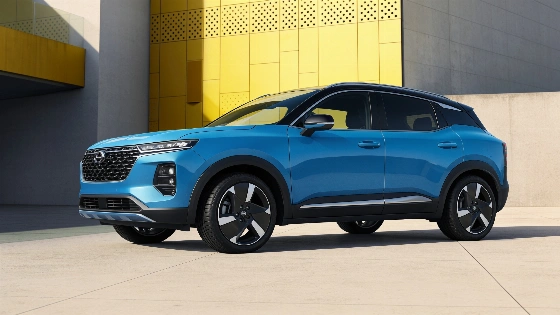
Nissan is bringing its Kicks e-Power SUV to Europe for the first time, with production set for Sunderland and a £170 million investment. The move signals a new phase in the brand’s electrification strategy and manufacturing footprint.
Nissan will start building the Kicks e-Power SUV in Sunderland, marking the model’s first appearance in Europe and bringing a £170 million investment to the UK plant. Christian Costaganna, Nissan’s CEO in Spain, announced the decision, which adds the Kicks to Nissan’s European range and highlights the company’s focus on hybrid technology as full electrification progresses at different speeds across markets. Reuters reports that this investment is part of Nissan’s broader plan to strengthen its European manufacturing and adapt to changing consumer demand.
The Sunderland plant, which has produced 12 million vehicles since 1986, will supply the Kicks to the UK, Europe, and Turkey. The factory already builds the Qashqai, Juke, and Leaf, and will add the fully electric third-generation Juke in 2027. Nissan’s total investment in Sunderland now reaches £5 billion, supporting 6,000 direct jobs and another 30,000 in the supply chain. The company has not yet given a start date for Kicks production at Sunderland, according to Reuters.
Nissan Kicks e-Power for Europe will use the brand’s third-generation hybrid system, where only the electric motor drives the wheels and the petrol engine acts solely as a generator.
The Kicks name is familiar in other markets, with over 1.8 million sold in more than 70 countries, but this is its first time in Europe. The European Kicks will use Nissan’s third-generation e-Power hybrid system. Unlike standard hybrids, e-Power uses a petrol engine only to generate electricity, while the wheels are powered by an electric motor. Drivers fill up with petrol as usual and don’t need to plug in, a setup Nissan expects will appeal to those not ready for a fully electric car. Electrive notes that the European Kicks’ e-Power system has been updated for 2025 to improve efficiency and reduce noise.
Spain plays a growing role in Nissan’s European plans. It is now the company’s second-largest market in Europe and ninth worldwide. In 2025, Nissan sold 38,254 vehicles in Spain, up 10%, with 81% of passenger cars sold being electrified. The Qashqai led the C-SUV hybrid segment with 19,556 units, and e-Power technology made up 60% of combined Qashqai and X-Trail sales. Costaganna said, “Spain is a key market for Nissan, not only for its size but for its strategic role in our transition to electrification and sustainable growth.”
While Nissan plans to cut its global model range from 56 to 45, the Spanish lineup will actually grow. Refreshed versions of the Ariya and X-Trail are coming, and the Micra and Leaf will stay. The electric Juke and new PIXO are also planned. Costaganna explained, “This reduction at a global level does not necessarily mean a reduction locally. In Spain, for example, the range grows.”
Nissan’s decision to invest in Sunderland is partly linked to the UK’s regulatory environment, with The Guardian noting that the company’s commitment may depend on potential easing of the British EV sales mandate. This highlights how automakers’ investment strategies are increasingly sensitive to government policies and incentives in the electric vehicle sector.
There are still hurdles to full electrification. Costaganna pointed out that Spain’s main challenge is not technology, but the pace of adoption. He called for “clear incentives, stable rules,” and better charging infrastructure to help build consumer confidence. Nissan expects the Spanish market to grow by 7–8% in 2026, but says the speed of electrification will depend on these outside factors.
The Kicks e-Power fits into Nissan’s “electrification with choice” approach, offering a hybrid below the Qashqai and X-Trail. Pricing, launch dates, and full technical details for the European Kicks have not yet been announced. The move is seen as a response to the different levels of consumer readiness for electric vehicles across Europe.
As reported earlier, Sunderland’s experience with e-Power technology—especially through the Qashqai—gives Nissan a solid base for this expansion. Since 2016, more than 1.9 million e-Power vehicles have been sold worldwide, including 200,000 built in the UK.
By making the Kicks e-Power in Sunderland and tapping into Spain’s growing demand for electrified cars, Nissan is taking a practical approach to electrification. The company’s investment in hybrid technology, rather than focusing only on pure electric models, shows an understanding of current market conditions. For buyers and industry observers, it’s a sign that Europe’s shift to electric vehicles will depend as much on consumer choice and infrastructure as on new technology.