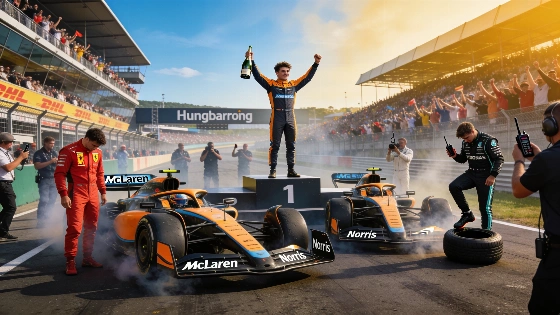
Lando Norris secured victory at the Hungarian Grand Prix after overcoming two mistakes. McLaren claimed a double podium, while penalties and technical issues reshaped the final standings. Ferrari and Mercedes faced setbacks.
Lando Norris emerged as the winner of the Hungarian Grand Prix, overcoming two significant mistakes during the race and capitalizing on a series of strategic shifts and incidents that defined the event. Starting from pole, Norris lost ground early after running wide, but managed to recover and maintain his lead, even as his teammate Oscar Piastri initially appeared poised for a breakthrough result. Piastri’s hopes faded following contact with Carlos Sainz and subsequent technical problems, leaving McLaren to focus on consolidating their advantage at the front.
The opening laps saw both Ferrari drivers opt for soft tyres in an aggressive bid to gain positions, but their efforts were quickly neutralized by strong starts from Piastri and Max Verstappen. Norris’s early error allowed Piastri to slip ahead, setting up a McLaren one-two at the front. Meanwhile, George Russell’s poor getaway left him at the back of the field, only ahead of Sergio Pérez, who started from the pit lane. Andrea Kimi Antonelli, in the mix with the Ferraris, faced a challenging task as the race unfolded.
Lewis Hamilton found himself locked in a tense battle with Verstappen, reminiscent of their recent duel in Austria. Hamilton struggled to pass the Red Bull, while Verstappen reported issues with his car’s suspension and gearbox. Ferrari attempted an undercut by pitting early, but Verstappen quickly reclaimed his position with a bold move, overtaking both Hamilton and Liam Lawson in a single corner. Hamilton’s difficulties continued as Red Bull kept Isack Hadjar on track to slow him down, but the Mercedes driver managed to overtake on the outside, only to lose further time during his own pit stop sequence.
McLaren’s split strategies soon became a focal point. As Piastri attempted to lap Sainz, the two made contact, costing the Spaniard valuable time and earning him a five-second penalty. The incident also frustrated Piastri, who voiced his anger over team radio. McLaren responded by calling Norris in for a pit stop, allowing him to take the lead unchallenged. Piastri’s race ended prematurely due to a gearbox failure, eliminating him from podium contention.
The race was further disrupted by a Virtual Safety Car, prompting Norris and both Ferraris to pit, while Verstappen and Antonelli stayed out. Norris retained his lead comfortably, but Charles Leclerc lost ground to Mercedes, and Hamilton narrowly avoided losing a position in the pit lane. However, Hamilton was penalized five seconds for speeding in the pit lane, which ultimately cost him a podium finish and allowed Leclerc to move ahead. Antonelli secured third place, salvaging his weekend after a Saturday penalty, while Russell finished seventh, keeping his championship hopes alive.
Elsewhere, Alonso and Sainz attempted to offset their poor grid positions by starting on soft tyres, but only managed to gain a single place each at the start. Both drivers reverted to their original positions once Russell recovered. Sainz followed a conventional two-stop strategy, while Alonso extended his first stint to 36 laps. Their paths crossed again during the incident with Piastri, which led to further frustration for Sainz. Both drivers used the VSC period to switch to soft tyres, sacrificing track position to their teammates. Alonso finished 14th behind Lance Stroll, while Sainz ended up 18th, trailing Alexander Albon. Aston Martin edged closer to the points, Williams slipped further back, and Cadillac continued to struggle with reliability.
The Hungarian Grand Prix highlighted the unpredictable nature of Formula 1, where strategy, penalties, and technical issues can rapidly alter the outcome. The race’s dramatic developments echoed the kind of unexpected twists seen in other recent sporting events, such as Richard Carapaz’s solo victory in the Tour de France, which also demonstrated how quickly fortunes can change at the highest level of competition. For more on how sudden shifts can define major races, see this analysis of a decisive cycling stage: Carapaz’s bold move in the Tour de France.
With the championship picture evolving after Hungary, teams and drivers now face renewed pressure to adapt strategies and minimize costly errors. The outcome in Budapest serves as a reminder that even small mistakes or unexpected incidents can have outsized consequences in the fight for points and podiums.