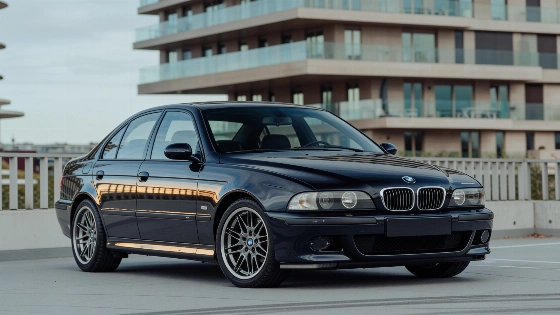
A unique BMW M5 E39 fitted with Volkswagen’s only W10 engine is about to hit the auction block. This prototype, once driven by Ferdinand Piëch himself, laid the groundwork for the legendary Bugatti Veyron’s powertrain.
In the world of rare cars, one BMW M5 E39 stands alone. It runs with a Volkswagen W10 engine under the hood. This car is now heading to auction, with experts expecting it to fetch between 250,000 and 350,000 euros. The story behind it is anything but ordinary. Ferdinand Piëch, Porsche founder’s grandson and a force behind modern supercars, ordered this secret project.
Broad Arrow Auctions will put this one-off up for sale at the Zoute Concours Auction in Knokke-Heist, Belgium, on October 9, 2026. That’s according to several independent automotive publications. The car’s value isn’t just in its story. It’s the only road car ever built with Volkswagen’s experimental naturally aspirated W10 engine. Only three of these engines exist.
The second W10 engine will be offered as a separate exhibit alongside the car at auction, while the third is believed to remain in Germany.
Back in 1999, Volkswagen engineers had a problem. They built a radical W10 engine, but none of their own cars could handle it. So they bought a BMW M5 E39. The team pulled out the original S62 V8 and swapped in the all-aluminum 5.0-liter W10. This engine made between 473 and 480 horsepower and about 592–593 Nm of torque, according to auction documents and independent sources. The car gained serious power and torque over the stock M5. It only got 11 kilograms heavier.
This wasn’t an official Volkswagen R&D project. It ran off the books, with a reported budget of around 2 million euros. Piëch liked the result so much he drove the car himself during development. Auction listings and automotive historians confirm only three W10 engines were ever built. One is still in Germany. One will be displayed with the M5 at auction. The third is inside this car.
Volkswagen engineers didn’t build a new prototype from scratch. They used a production BMW M5 E39 chassis, kept rear-wheel drive, and left the six-speed manual transmission. This let them test the W10 engine in real-world conditions. Industry analysts have pointed out how unusual this approach was.
The W10 engine was constructed on Volkswagen's narrow-angle VR architecture, effectively combining two five-cylinder VR5 units into a single ten-cylinder, all-aluminum, naturally aspirated powerplant. This configuration was a key experimental step in the evolution of Volkswagen's W-shaped engines, which would later culminate in the development of the W16 for Bugatti.
The W10’s roots go back to Volkswagen’s earlier engine experiments. The VR6, launched in 1991, started a new era for W-shaped engines. Its compact design led to the W8 and W12, which powered the Passat and Phaeton. The W10 was a step too far for mass production. It stayed a prototype. By combining two VR5 units, Volkswagen created a key stepping stone toward the W16 engine. That engine would later power the Bugatti Veyron and Chiron.
The BMW M5 E39 W10 was never approved for road use. It’s the only road car with a Volkswagen W10 engine. That makes it unique. Broad Arrow Auctions will offer it on October 9. For collectors, this is a rare shot at owning a car that links BMW, Volkswagen, and Bugatti.
Fans of rare engineering will see the appeal. As reported earlier, vehicles with one-of-a-kind stories keep drawing crowds and respect from collectors and enthusiasts.
Volkswagen dropped the W10 for production cars. They chose the W12 for models like the Audi A8 and Volkswagen Touareg. That decision cleared the path for the W16’s debut in the Bugatti Veyron. This BMW M5 E39 W10 is more than a technical oddity. It shows what happens when engineers take risks. Its auction appearance proves that big breakthroughs often start as secret experiments. The legacy of visionaries like Ferdinand Piëch still shapes the car world. Some stories never fade.