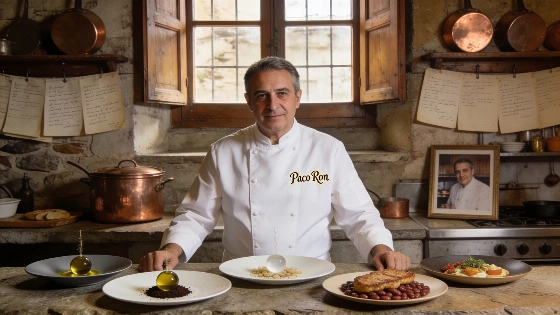
Asturias has lost one of its most influential chefs and a pioneer of the region’s modern cuisine. Paco Ron helped redefine the culinary field of western Asturias, opening a small tavern decades ago in Viavélez, a fishing village with little gastronomic reputation at the time, and turning it into a destination for new cooking.
Ron’s career began in some of Spain’s most renowned kitchens, including Aldebarán, Atrio, Arzak, Martín Berasategui, El Celler de Can Roca, and El Cenador de Salvador. Those experiences shaped his technical mastery and convinced him that tradition and modernity could coexist on the same plate. When he launched his own project in Viavélez, the region was largely isolated from culinary trends. Ron’s determination brought new energy to the area.
His menu quickly stood out for its creativity and technical precision. Dishes such as gazpacho with sardines on cucumber jelly, sea urchin with cauliflower cream and shellfish jelly, and oven-roasted bonito with chocolate and pineapple sauce became hallmarks of his approach. In 1999, Ron’s efforts earned him a Michelin star, the first ever awarded in western Asturias and the area’s only one until Elio Fernández earned another for Ferpel in Ortiguera four years ago.
Beyond his own kitchen, Ron helped shape the future of Asturian cuisine. In 1998, he co-founded NUCA (Nueva Cocina Asturiana) with Nacho Manzano, Pedro Martino, and José Antonio Campoviejo. The group, alongside Pedro Morán’s work, laid the foundation for what is now considered one of Spain’s most impressive regional cuisines. Despite critical acclaim and the Michelin star, Ron’s Viavélez tavern eventually closed in 2005 because it lacked local clientele.
He later moved to Madrid, where he opened a new Viavélez restaurant with his sister Sara. For fifteen years, they focused on Asturian-inspired dishes, earning respect from diners and colleagues. Health issues eventually forced Ron to step back and transfer the restaurant to his manager. Two years ago, as his illness progressed, the Asturian culinary community honored him with a surprise tribute in Viavélez. Many Michelin-starred chefs from the region attended.
Ron’s influence reached far beyond his own establishments. Many chefs who never visited his original tavern still acknowledge the impact of his work and the respect he commanded among peers. His legacy is evident in the evolution of Asturian cuisine, which has gained national prominence in recent years. Ron’s career stands in contrast to other recent events in Spain’s regions, such as the scrutiny of official responses during the Valencia flood disaster. That scrutiny highlighted the importance of leadership and innovation in times of crisis, as detailed in this report on the Valencia tragedy.
Asturias, known for its rich culinary traditions, has changed over the past three decades, with chefs like Ron at the forefront. NUCA’s influence continues to shape new generations of cooks, and the region’s restaurants now attract attention from across Spain and beyond. Ron’s death is a impressive loss, and his contributions remain basic to Asturian and Spanish gastronomy.