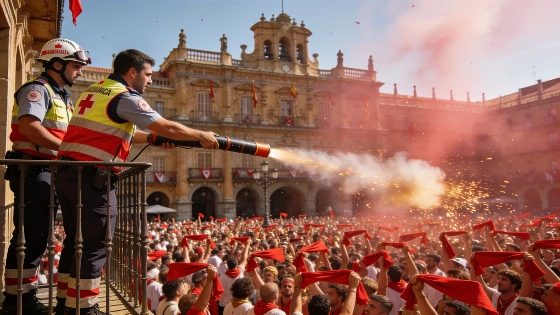
San Fermín 2026 began at noon with the Chupinazo from Pamplona’s city hall. Over 12,500 people gathered as medical professionals launched the festival’s opening rocket. The event marks the start of Spain’s most international celebration.
The San Fermín 2026 festival officially opened in Pamplona at midday, as thousands gathered in the city’s main square to witness the Chupinazo—the traditional rocket launch that signals the start of nine days of festivities. This year, the honor of igniting the opening was given to Clint Jean Louis, subdirector of Urgencias de Navarra, and Araceli Sergio, a nurse from the UVI móvil de Tafalla. Their appearance on the city hall balcony drew cheers from a crowd estimated at more than 12,500, many of whom had arrived early to secure a spot in the packed plaza Consistorial.
Although the Chupinazo is now a defining moment of San Fermín, it is a relatively recent tradition, first introduced in 1941. The ceremony unfolds with precision: three minutes before noon, the designated launchers step onto the balcony, accompanied by a municipal usher and the head of the Caballer pyrotechnics company, which manufactures the rocket. As anticipation builds, the crowd chants “¡San Fermín!, ¡San Fermín!, ¡San Fermín!” and waves red handkerchiefs, a symbol that will soon be tied around their necks for the duration of the festival.
The official start is marked by the sound of clarinets, followed by a greeting in both Spanish and Basque. The launchers then proclaim the traditional call: “Pamploneses, pamplonesas. ¡Viva San Fermín! ¡Gora San Fermín!” The moment is broadcast live on giant screens throughout Pamplona and can be followed worldwide via TVE, ensuring that the festival’s reach extends far beyond the city’s historic center.
San Fermín is recognized as one of Spain’s most internationally renowned festivals, drawing visitors from across the globe. The Chupinazo is just the beginning: over the next nine days, Pamplona will host a series of events, including the famous running of the bulls, concerts, and cultural activities. The festival’s unique blend of tradition and spectacle has made it a focal point for both locals and tourists. For those interested in the broader scope of this year’s celebrations, including expanded TV coverage and the return of live bull runs, further details are available in this overview of San Fermín 2026’s broadcast innovations and festival highlights.
San Fermín’s origins date back centuries, but the modern festival has evolved significantly since the mid-20th century. The Chupinazo, now a symbol of Pamplona’s identity, was established to provide a clear and communal start to the festivities. The event’s organization involves coordination between city officials, emergency services, and local businesses, reflecting its importance to the region’s economy and cultural life. The influx of visitors during San Fermín has a notable impact on Pamplona, with hotels, restaurants, and public services operating at full capacity. The festival’s international profile has also led to increased media attention and safety measures, particularly around high-profile events like the bull runs. As the city embarks on another year of celebration, the Chupinazo remains a powerful reminder of Pamplona’s enduring traditions and its role as a gathering point for people from around the world.