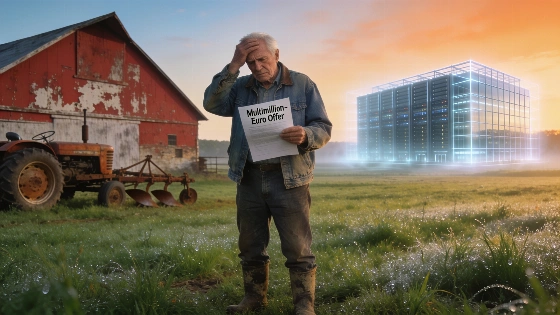
An 86-year-old farmer in Cumberland County, Pennsylvania, refused a multimillion-euro offer from developers seeking to build a data center on his land. Instead, he secured a legal agreement to protect his family's farm from future urbanization, prioritizing heritage over profit.
When developers offered Mervin Raudabaugh more than $15 million—nearly €13 million—for his two adjoining farms in Cumberland County, Pennsylvania, the 86-year-old farmer faced a decision that would define his legacy. The buyers wanted his 261 acres to build a data center, part of the expanding infrastructure for artificial intelligence. Raudabaugh, however, chose to protect the land that had shaped his life, declining the record sum in favor of a future rooted in agriculture.
Instead of selling, Raudabaugh accepted approximately $1.9 million for the development rights to his 105-hectare property. This legal arrangement, known as a conservation easement, allows him to retain ownership while permanently prohibiting industrial or urban development. The land can still be inherited or sold, but its use must remain agricultural, regardless of future owners.
Personal History and Family Ties
Raudabaugh’s connection to the farm runs deep. As a teenager, he took on much of the agricultural work after his mother passed away in the old barn where the family milked cows. Later, he and his wife Anna Mae raised their children on the same land. For over five decades, he managed dairy cattle, then beef, and continued to grow corn and soybeans well into his eighties. “I love this land. It’s been my life,” he told FOX43, explaining why he could not let it be transformed into a data center.
Months of Relentless Pressure
The developers’ pursuit was persistent. Raudabaugh received repeated calls and offers, with agents proposing up to $60,000 per acre. Even after the conservation agreement was finalized on December 30, real estate intermediaries continued to reach out, hoping he might reconsider. But the farmer stood firm, prioritizing the preservation of his family’s legacy over financial gain.
Legal Safeguards for the Future
The deal was made possible through the Silver Spring Township Land Preservation Program, with Lancaster Farmland Trust responsible for enforcing the agreement. The initiative is funded by a local income tax, approved by residents in 2013, to protect farmland, forests, and open spaces. Raudabaugh’s decision ensures that his property will remain a working farm and a haven for wildlife, including deer and turtles, for generations to come.
Wider Pressures on American Farmland
Raudabaugh acknowledges that not every family can afford to turn down such lucrative offers. Rising costs for equipment and operations, combined with soaring land values, make it increasingly difficult for small farms to survive. His hope is that future generations will appreciate the value of keeping agricultural land intact, even as the demand for data centers and other industrial projects grows across rural America.
Stories of individuals choosing preservation over profit are rare but not unique. In a similar vein, a young couple in Spain transformed an abandoned rural plot into a self-sufficient home, highlighting the challenges and rewards of sustainable living. Their journey, detailed in this report, underscores the broader movement to protect rural spaces from commercial development.
Raudabaugh’s stand is a reminder that, even in the face of immense financial temptation, the value of land can go far beyond its market price. For some, heritage and stewardship outweigh any sum developers might offer.