In Barcelona, Hoare traces Blake’s sea creatures through Melville and T. E. Lawrence. His 520-page book takes an associative route that can leave readers searching for the thread.
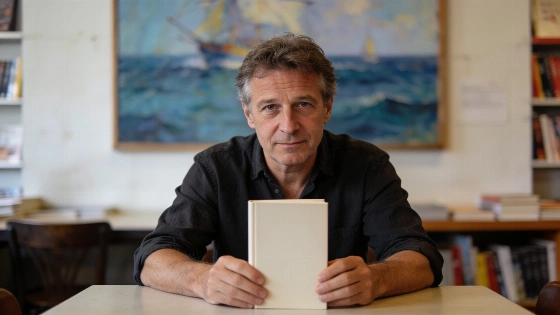
At his Barcelona presentation, Philip Hoare keeps circling back to the sea. The British writer argues that its creatures belong at the centre of William Blake’s imaginative world. He builds his case through art and literature. Personal memory supplies another current, rather than a straight biographical line.
Hoare’s route to the whale runs partly through Herman Melville and the image of the Leviathan. Blake’s «terrible simetría» becomes, in Hoare’s reading, a link between tiger and cetacean: «Un tigre como una ballena como un poeta». The comparison captures the method of a 520-page book that gathers figures and stories like objects left behind by the tide. El País identifies William Blake y los monstruos marinos del amor as a 2026 title from the Spanish publisher Ático de los Libros.
El País identifies William Blake y los monstruos marinos del amor as a 2026 publication from the Spanish publisher Ático de los Libros.
The method gives the book its pull. It can also send readers searching for the thread.
Hoare describes the book as a literary gathering. Derek Jarman appears alongside Paul Nash. Oscar Wilde shares space with John Singer Sargent. Ruskin meets Joyce, while Yeats is set beside Francis Bacon. Iris Murdoch joins Peter Beard, and Nancy Cunard rounds out the gathering. Hoare calls himself a fan, sometimes shy in the presence of artists he admires. The associations wind so far that readers may lose their way; he asks them to trust the current.
Blake is no decorative name in this procession. Hoare rejects the lingering habit of dismissing the poet and artist as a madman. He reads Blake as a serious modern creator. The work remains elusive and intense, and Hoare sees it as ahead of its time. Its afterlife runs through William Burroughs and Allen Ginsberg. David Bowie is another point of reference.
For Hoare, the argument is physical, too. He recalls trembling before El fantasma de una pulga at the Tate. Its painted figure seemed to him like a gargoyle or a visitor from hell. An encounter with Newton left a lasting impression. So did Nabucodonosor, and Piedad stayed with him as well. Hoare says Blake helped him heal while he was ill. He approaches the artist’s images and words as experiences that need no explanation before they can be felt.
The available search did not surface an Ático de los Libros press release or catalogue, a programme for the Barcelona presentation, or separate reviews that could independently confirm the book’s publication details or contents.
The book’s other compelling presence is T. E. Lawrence. Hoare visits Lawrence’s cottage at Clouds Hill and follows his connection to water. Lawrence swam and exposed himself to cold water. He also designed fast boats for the Navy, then tested them. Lawrence said Los siete pilares de la sabiduría emulated Moby Dick. He regarded himself as Blake’s disciple and admired the phrase «todo lo que es, es sagrado». Hoare calls him the book’s most interesting figure and describes a man who was deeply troubled.
Hoare’s lifelong habit of swimming wherever he travels helps explain the sea’s place in the book. He wrote about whales in Leviatán o la ballena. Alberto y la ballena also takes whales as its subject, while El mar interior turns to the sea. Blake’s world, as Hoare reads it, holds fallen angels alongside satanic figures. Strange marine forms appear, as do predatory fish and deep-sea dragons. Hoare sets Blake beside Milton: El paraíso perdido is extraordinary, he says. Blake is rougher and more difficult. Hoare also finds him modern and queer. The tiger poem remains his point of return when he is disturbed and when he visits the poet’s grave.
A Cape Cod lobster fisherman was caught in a humpback whale’s mouth and suffered broken legs, but was not swallowed. Hoare jokes that he would like to end up inside a whale like Jonah. He acknowledges that this would be unpleasant for the animal. Apparently, swallowing a person is scientifically impossible.