Seville artist Pilar Albarracín has received Spain's 2026 National Visual Arts Award. Her performances question folklore, gender and power through a feminist lens.
On 29 September 2026, Spain's Ministry of Culture announced Pilar Albarracín as the winner of the Premio Nacional de Artes Plásticas 2026. The Seville artist has built her career through performance, photography, video and installation. Her work questions folklore and collective identity through a feminist view of Spain.
The Ministry will give Albarracín 30 thousand euros. The jury praised the singular and recognisable path she has built. It also pointed to her critical revision of Spanish cultural imagery and its links to gender, tradition, folklore and power structures.
Alongside the 30,000-euro prize, the award includes an individual exhibition at the Museo Reina Sofía, according to EFE.
Her method is direct. She takes the cañí stereotype and makes it unstable. Flamenco dresses, bullfighting references and the Spanish doll stop acting as decoration. They become tools for asking how Spain presents itself.
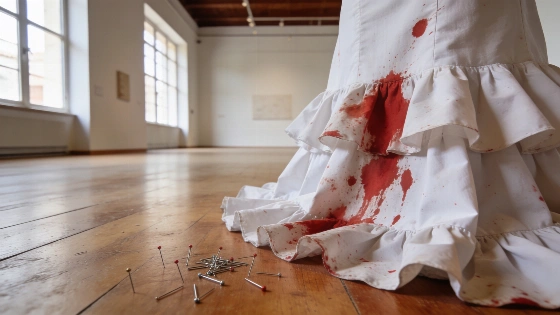
That approach appears in Techo de ofrendas, where hundreds of flamenco dresses hung from the ceiling. In Lunares, she marked a faralaes dress with her own blood. Tartero placed a full-size stuffed fighting bull at the centre of the work. Musical Dancing Spanish Doll(s) examined the familiar Spanish doll cliché.
Her work has reached audiences well beyond Spain. She has exhibited at MoMA PS1 in New York, the Hamburger Bahnhof in Berlin, the Musée d'Art Moderne de la Ville de Paris and Kiasma in Helsinki. The jury said this international presence placed her work within global contemporary art discussions. It also widened the way questions about Spanish culture could be treated.
The jury’s meeting was reported to have taken place on Tuesday, chaired by Ángeles Albert, director of cultural heritage and fine arts, with Jesús Carrillo Castillo serving as vice-chair. The Ministry’s wider rationale also emphasised Albarracín’s use of performance, photography, video and installation to reconsider the representation of the body through irony and theatricality.
The award adds institutional weight to a career that has examined Spain from both inside and outside. In Viva España (2004), Albarracín walked through central Madrid in a yellow coat, high heels and sunglasses. A popular band repeated the pasodoble with the same title. She described the performance as an attempt to rethink Spanish culture, where celebration and violence can exist together.
The contrast matters.
The performance belongs to four foreign collections: Louis Vuitton, the Musée d'Art Moderne de la Ville de Paris, a private collection in Washington and another in Portugal. A separate Madrid public-space report recently showed another use of the capital's streets. Albarracín's work also turns a familiar Spanish setting into a question about identity.
Albarracín has paid particular attention to Andalusian women and traditions that remain visible in daily life across southern Spain. In 2015, she appeared on the cover of Toros dressed as a female bullfighter and holding a cooking pot. The image linked the bullfighting world's language of struggle with the daily battles associated with women.
Her own account reaches beyond Andalusian folklore. She wants to revisit what is Spanish while valuing different forms of folklore. She also wants to place tradition within a framework of greater equality, justice and creativity. This year, her work entered the collections of the Reina Sofía and the IVAM. She has argued that Spain took time to look at itself.
The Premio Nacional de Artes Plásticas was established in 1980. The award record lists Dora García in 2021, Rogelio López Cuenca in 2022, Teresa Lanceta in 2023, Pedro G. Romero in 2024 and Fina Miralles in 2025 as previous recipients.
Albarracín's selection gives strong institutional backing to art that does not leave national imagery untouched in a museum. Her work asks who controls those images and whom they represent. El País and EFE described her career as one of the most recognisable and distinctive in contemporary Spanish art, with significant international recognition.