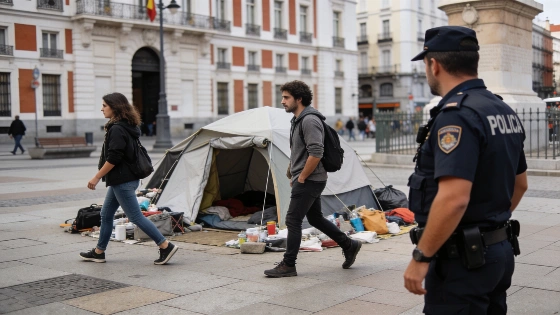
The Confederación Española de Policía says the Puerta del Sol encampment is blocking normal access to a public square. Its spokesperson is urging Madrid's government delegate to act as the dispute over security and responsibility grows.
The encampment began on 26 September after a demonstration over Spain's housing crisis and the eviction of 87-year-old Maricarmen. Dozens stayed in Puerta del Sol that first night; later reports counted roughly 100 tents and around 600 people.
David Gutiérrez of the Confederación Española de Policía says the camp should now be dismantled because people cannot move through the square normally. He argues that the site no longer functions as a common public space.
Gutiérrez made the remarks on La Noche de Cuesta. He rejected the idea that the gathering remains peaceful simply because no physical clashes have occurred. In his view, blocked access can itself create a public-order problem.
The dispute turns on duration. Gutiérrez says the legal requirement to notify authorities of a demonstration exists because a road or square may be occupied for a defined period. He does not believe notification permits an indefinite presence. He also cited the Constitution's assignment of public security to the state as grounds for action by the relevant authorities.
That argument puts pressure on Government Delegate Francisco Martín Aguirre. Gutiérrez compared Madrid with Ceuta, where he said the Government Delegate had already acted two months late. He said Madrid was even further behind, as assaults on Policía Nacional officers in the region have risen year after year.
The official line was softer. Francisco Martín described the camp as peaceful and said law enforcement's task was to protect public safety. A source close to the Interior Ministry said responsibility would remain with the municipal police as long as there were no incidents. National forces could step in if disorder emerged.
Madrid City Hall accused the central authorities of inaction and demanded an explanation for the delay. Municipal sources said police had withdrawn after unauthorised tents appeared. Central authorities disputed that account.
Manos Limpias also announced a complaint against Francisco Martín. The group accused him of possible failure to perform his duties and of aiding the camp, adding a legal dispute to the political one.
Gutiérrez linked the argument to wider policing problems in the Community of Madrid. He said officers were confiscating more bladed weapons in the streets, while stabbings and attempted homicides were rising alongside sexual assaults.
The Confederación Española de Policía says it has sought more staff for the Policía Nacional and Guardia Civil for years. Gutiérrez wants the Government Delegate to expand the authorised staffing structure. He says this should take priority over issues he considers unrelated to security.
The immediate questions are whether the camp has produced physical incidents and whether a prolonged occupation can continue when access for other residents is restricted. Responsibility for public order remains disputed between the police and the Government Delegation.
AFP and EFE place the camp within a wider wave of protests over housing costs and evictions in Spain, with demands for stronger tenant protection. The demonstrations also include calls linked to the government's housing decree. Estimates changed quickly, so the reports need to be read together.
One report referred to dozens of participants. Another mentioned roughly 100 tents. A later account put the number at around 600 people.
The police union's position is clear: one group cannot hold a public square indefinitely if normal passage is blocked. If the occupation is unlawful or exceeds the limits of a notified demonstration, the Government Delegation must address it through the proper legal and policing channels.
Public-order decisions also depend on available police resources. The reported rise in assaults and the long-standing demand for more staff remain part of the same dispute.