Top police officials rejected a report that would have absolved Morocco of involvement in the Ceuta border incident. The move highlights internal resistance to the official government narrative. Tensions remain high over responsibility for the mass entry.
Spain’s official account of the Ceuta border crisis is under scrutiny after senior police leaders refused to sign off on a report that would have cleared Morocco of any role in the mass entry of migrants. Police sources confirmed the internal standoff to ABC, marking an unusual public disagreement between law enforcement and the government’s preferred version of events.
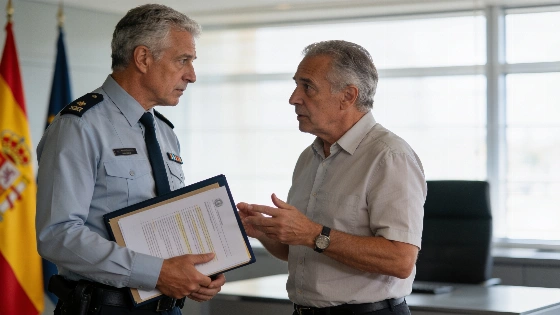
The dispute began when the director general of police, Francisco Pardo Piqueras, called a high-level meeting to draft a report in line with the Interior Ministry’s position: that Morocco was not involved and that there were no prior warnings before the July 30–31 surge. Julián Ávila, commissioner general for Immigration and Borders, and several of his subordinates declined to approve the document. They argued that dismissing Moroccan responsibility was premature and not backed by evidence.
According to Reuters, the disputed police report prepared by the National Center for Immigration and Borders (CENIF) claimed Moroccan forces showed 'total permissiveness' and did not seriously disperse the crowd at the border.
The report in question, prepared by the Centro Nacional de Inmigración y Fronteras (Cenif), described Moroccan gendarmes as cooperating with migrants during the breach. Ávila and his team noted that no other official report existed apart from Cenif’s, and later risk analyses did not rule out Moroccan involvement. The commissioner general for Information also declined to assign blame, keeping the investigation open.
Pressure from the Interior Ministry increased after Fernando Grande-Marlaska demanded a quick update on September 1. Hours later, the ministry sent a letter to Pardo Piqueras requesting immediate details from the report for crisis management. Despite this, José Luis Santafé, another senior official, signed an internal note stating that no government or person could be definitively linked to the mass entry on August 30 and 31, 2026.
The Interior Ministry later tried to downplay the Cenif report, clarifying that Cenif is not an official judicial police body and has no staff in Morocco. Its relationship with Moroccan security services is described as collaborative, not operational. This appeared aimed at reducing the impact of findings that suggested Moroccan police had relaxed border controls and even cooperated with those crossing into Ceuta.
On September 3, 2026, Prime Minister Pedro Sánchez publicly stated that Spanish authorities have no evidence Morocco organized or executed the Ceuta border surge, emphasizing that no institution has provided 'reliable proof' of such claims. The Ministry of the Interior also confirmed there is no police report attributing planning or execution of the July 30–31 events to Moroccan forces.
The episode has revealed deep divisions within Spain’s security forces over how to interpret and respond to the Ceuta incident. The government’s effort to shield Morocco from blame contrasts with police leaders’ reluctance to endorse conclusions not fully supported by evidence. This internal conflict follows earlier disputes, such as the previous investigation into the Interior Minister’s public defense of Moroccan cooperation.
Ceuta’s border remains a pressure point for Spain’s migration policy, with each incident testing the limits of cooperation and internal accountability. The refusal of top police officials to approve a politically convenient narrative is a rare show of institutional independence. In a climate where official reports are often shaped by diplomatic priorities, this episode highlights the tension between operational realities and government messaging. The outcome could affect Spain’s approach to future border crises and the credibility of its security institutions when political pressure meets professional judgment.