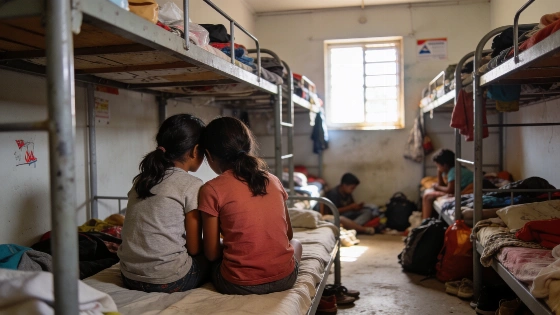
Ceuta’s child protection system is overwhelmed with over 1,700 minors. The Ministry of Juventud e Infancia has 500 places ready on the mainland, but the PP’s refusal to sign off leaves vulnerable girls in limbo. The crisis exposes deep political rifts.
Five hundred migrant girls remain stuck in Ceuta as the Partido Popular (PP) refuses to authorize their transfer to the mainland, halting an emergency relocation plan. The Ministry of Juventud e Infancia has secured places for them in private centers across Spain, but the PP-led city government has not signed the required agreements. Ceuta’s child protection system, already stretched far beyond capacity, is left to manage the crisis alone.
Two weeks ago, the Ministry, led by Sira Rego, announced it had arranged urgent transfers for these minors to facilities that can take 20 to 30 children each. The plan depends on agreements with private organizations. Ceuta’s officials now say they have not received written confirmation of these places and argue that such arrangements are not standard outside existing regional frameworks.
According to official data cited by RTVE, of the 760 girls in Ceuta's protection system, 233 are under the age of 13.
Official figures show the scale of the problem: Ceuta currently houses 1,711 children and adolescents in facilities built for just 29. The central government estimates the real number could be as high as 2,500, with many still unregistered. With a population of only 84,000, the city is struggling to provide basic services like education and healthcare to the new arrivals.
The Ministry says all legal and logistical requirements have been met. Ceuta’s administration points to Article 18.4 of the Ley de Protección Jurídica del Menor and a 2015 protocol, which they interpret as requiring prior communication and sometimes authorization from the receiving region. The Ministry argues that, since Ceuta holds guardianship, it can arrange transfers directly with private entities—a process used before in the Canary Islands.
Politics are at the center of the deadlock. The PP, which governs Ceuta, has made opposition to accepting unaccompanied minors a key issue in the current migration debate. The national party’s stance puts pressure on local officials, making it politically risky to approve transfers without broader party backing. With elections approaching, the government in Madrid is wary of public negotiations that could stall any solution amid rising partisan conflict.
In late August, the Ministry of Juventud e Infancia was working on emergency routing and funding, with €25 million in state support already discussed for Ceuta. Reports indicate the plan involves relocating girls to small-scale centers across various Spanish regions.
Other proposals have been floated. The Ministry suggested bilateral agreements between autonomous communities to speed up transfers and offered to fund the 500 places using money already allocated to Ceuta—€25 million in emergency credit and €62.5 million under a recent royal decree. These options are also stalled by ongoing political and technical disputes.
Ceuta’s officials have called for "co-responsibility" from other regions, asking for temporary space to keep the minors safe while a long-term solution is found. But the legal process for extraordinary transfers, set by a 2025 royal decree, is slow and not suited to the current emergency. City leaders say the lack of written guarantees from host organizations is a major obstacle, while the Ministry insists all necessary documentation has been provided and discussed in meetings.
This is not the first time Ceuta has faced this kind of isolation. As previous coverage has shown, the city’s appeals for help have often run into political divisions at the national level, leaving it to handle crises on its own.
The current standoff highlights the limits of Spain’s migration system when party interests outweigh humanitarian needs. Despite available resources and legal options, the refusal to move forward reflects a political calculation that puts electoral concerns ahead of children’s welfare. Unless the PP changes its position or the central government finds a way around local resistance, hundreds of girls will remain in overcrowded shelters, caught in a political stalemate with no clear end in sight.