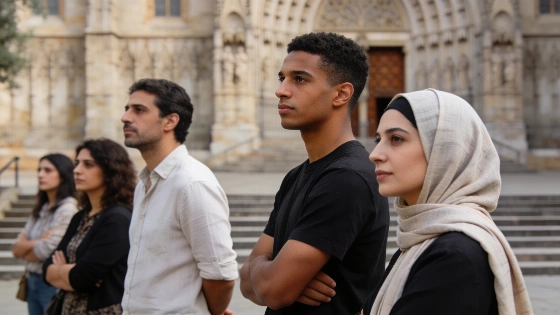
Pope Leon XIV Makes Migration a Key Theme During Visit to Spain. Pope Leon XIV focused attention on migration and the personal stories of newcomers. His approach stands apart from the usual data-driven discussions. At the center are individual lives and integration into Spanish society.
During Pope Leon XIV's visit to Spain, the issue of migration came to the forefront. The head of the Catholic Church emphasized that fighting racism is impossible without focusing on personal stories, rather than just statistics. This approach resonated not only with believers, but also with those who do not identify with the Catholic tradition.
The Pope paid special attention to how newcomers are perceived and integrated in Spain. In his opinion, society should see migrants not as abstract categories, but as people with names and destinies. This statement comes amid ongoing debates in the country about the role of migration and how public opinion about newcomers is formed.
Spain officially remains a secular state, yet Catholic culture still influences daily life. Pope Leon XIV reminded that tradition can be not only a symbol of national identity, but also a space for dialogue between different cultures and religions. This approach allows integration to be seen not as a threat, but as an opportunity for mutual enrichment.
In recent years, debates have intensified in Spain around the terms used for migrants: "menas," "illegals," "invasion." These words are often used to depersonalize and create distance. Pope Leon XIV suggested changing the rhetoric, focusing on specific stories and individuals, which, in his view, can change public perception and reduce tension.
The Pope's visit coincided with other significant events in the country. For instance, on the day of his arrival, morning road blockades were canceled in Catalonia to ensure the exams could take place and to provide security for events related to the pontiff's visit. This was previously reported in a piece about measures taken by universities in the region: the authorities reinforced the reserve teaching staff for the duration of the exams.
Pope Leo XIV himself has migration experience: he was born in the USA, grew up in Peru, and now leads the Vatican. According to observers, this personal background allows him to better understand integration challenges and the difficulties faced by migrants in Europe. In Spain, where issues of migration and identity remain pressing, such an approach by the pontiff could prompt a reexamination of attitudes toward newcomers.
For reference: according to Eurostat, Spain is among the EU countries with the highest number of migrants, and in major cities such as Madrid and Barcelona, the proportion of residents with foreign roots exceeds 20%. In recent years, the country's authorities have repeatedly adjusted migration policy, seeking to balance the interests of the economy, social stability, and humanitarian commitments. The visit of Pope Leo XIV and his emphasis on personal stories may intensify public debate on ways of integration and the role of tradition in modern Spain.