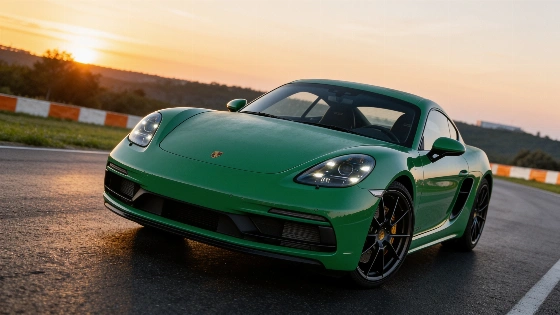
Porsche CEO Michael Leiters has confirmed that the next-generation 718 Boxster and Cayman will proceed as battery-electric sports cars, with no petrol-powered versions planned. The decision ends months of uncertainty over the models’ future. Before driving a development car, Leiters had been “very, very skeptical.” He later praised its driving character. In an interview reported by Motor1 Italy, he described it as “a fantastic car, with incredible driving pleasure.”
The program follows Porsche’s 2022 announcement that the 718 successor would switch to electric propulsion. The reported timetable points to a market launch in 2027, with 2028 expected to be the first full production year. The combustion-powered 718 Boxster and Cayman have been discontinued, making the electric cars their successors, not additional versions alongside them.
The decision follows a turbulent period for Porsche. Last year, the company stopped selling the standard 718 Boxster and Cayman worldwide, leaving only the high-performance Spyder RS and Cayman GT4 RS available in Spain. Conflicting reports, including coverage by Bloomberg, fueled questions about whether the next generation would remain exclusively electric.
Strategic Shift Under New Leadership
Leiters, who took over from Oliver Blume earlier this year, faces the challenge of restoring profitability after Porsche’s aggressive electrification push under Blume led to a €1.8 billion drop in operating profit. Financial pressure has sharpened the focus on the economics of individual vehicle programs. Reported 2025 revenue was €36.27 billion, down 9.5%. Operating profit fell from €5.64 billion to €413 million, while the operating margin declined from 14.1% to 1.1%, information from figures reported by Người Quan Sát.
In a recent interview with Frankfurter Allgemeine, Leiters acknowledged that the electric 718 project had been at risk, but argued that continuing development was Porsche’s most viable path. “With the electric 718, we concluded that building the model is the best economic solution and it will become a fantastic car,” he said. In separate reported comments, he called the electric 718 the “best solution economically.”
The business case partly depends on sharing development costs beyond a niche two-seat sports-car program. AutoNext links the underlying architecture to Audi’s production version of the Concept C electric sports car, potentially broadening the platform’s customer base. The battery is reported to sit behind the seats, in the space traditionally associated with the flat-six engine.
Potential Platform for Audi’s Electric Sports Car
The electric 718 could have wider implications within the Volkswagen Group. German media have linked the platform to speculation about an electric successor to the Audi TT. Separate reports have also connected it to the production version of Audi’s Concept C. These links point to potential group-wide economies of scale, but do not establish that the Concept C or a TT successor will share every component with the Porsche models.
Leiters has said Porsche assesses a project on its own commercial merits before considering group synergies: “Initially, I analyze each project exclusively from Porsche’s perspective: does it make economic sense or not? Only then do possible group synergies come into play.” The shared architecture is part of the business rationale, but Porsche must also make its own case for the 718.
Combustion Engines Remain in Porsche’s Wider Lineup
Porsche’s commitment to an electric-only next-generation 718 does not end combustion engines across the brand. Its wider strategy includes electric models such as the Taycan and Macan. An electric Cayenne is also part of the lineup, alongside combustion-powered models. Leiters has distinguished the 718 program from a separate, more expensive electric mid-engined supercar above the 911, saying Porsche sees insufficient demand for a battery-electric car in that segment.
The electric 718 Boxster and Cayman are planned as successors to the discontinued combustion versions. Decisions about other Porsche models depend on their market position and business case. The next-generation 718 is not expected to retain naturally aspirated six-cylinder engines in high-performance variants. That includes the Cayman GT4 and GT4 RS, as well as the 718 Spyder RS.
Context and Outlook
Porsche’s decision to press ahead with electric sports cars comes as the European EV market continues to evolve. The company’s approach contrasts with that of other manufacturers, such as Leapmotor, whose B10 model recently became Spain’s best-selling electric car in July, as reported in a recent analysis of Spain’s EV market. For Porsche, the 718 program pairs a defined electric-only direction with an effort to make a low-volume sports-car architecture more economical through potential group sharing.
The reported launch window is 2027, followed by a first full production year in 2028. Porsche’s wider strategy still includes electric and combustion-powered vehicles, but the next-generation Boxster and Cayman are set to return as electric-only sports cars.