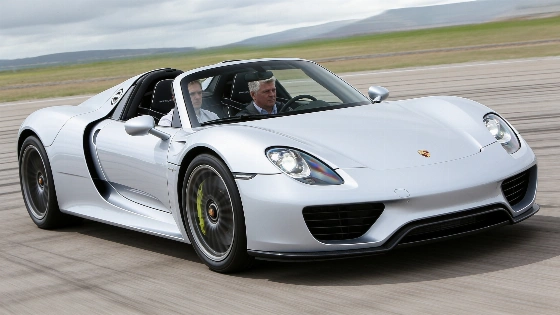
Porsche has announced a new mid-engine supercar platform designed to top the 911 and reshape the brand’s hierarchy. The Mission S prototype will break cover on October 15. It follows in the footsteps of the 918 Spyder, Carrera GT and 959, marking one of Porsche’s boldest leaps in years.
The news came at Porsche’s Capital Markets Day in Weissach, where the company unveiled its ‘Sportwagenschmiede ’35’ plan. Porsche will build a new architecture specifically for mid-engine supercars. This is a new family of ultra-rare models positioned above today’s flagship, not a tweaked 911. Porsche describes the project as a forward-looking step rather than a finished production car, and says it could form the basis for future top-tier vehicles.
Porsche has confirmed only one specification so far: the new car will have a combustion engine mounted in the middle. The company has not said whether it will run solely on gasoline, be a plug-in hybrid or use another configuration. Porsche remains committed to its three-way powertrain plan, continuing to invest in combustion engines, plug-in hybrids and new battery technology. Motor1 and Porsche’s own statements say the company has not disclosed the engine’s power, cylinder count, gearbox, production dates or range.
The Mission S name appeared in a teaser video on social media and is likely intended only for the prototype. Porsche’s plan to show the car in October signals its ambition to make an impact in the supercar world. The Mission X electric hypercar project was shelved after weak market interest in zero-emission supercars. Porsche has never officially attributed Mission X’s end to low demand, but, so that connection remains unconfirmed.
Porsche’s product plan extends beyond one headline car. The brand will cut model variants by about 20%, aiming for each version to sell about 30% more. In the medium term, Porsche plans to reduce the number of model variants by about 20% while increasing average sales per version by 30%. Porsche is shifting its focus to the D and E segments, with the goal of making these premium cars about 45% of its lineup. The Sportwagenschmiede ’35 plan gives greater weight to these high-margin models as Porsche pursues greater exclusivity and profit.
Porsche is also working on a D-segment SUV that will sit above the Cayenne, while the 911 will get more extreme versions. A new B-segment SUV with combustion and hybrid power is due in 2028 and will run alongside the electric Macan. The next 718 Boxster and Cayman will be fully electric, with their first full production year also set for 2028. Motor1 reports that Porsche’s 2026 strategy does not include the return of gasoline-powered Boxster and Cayman models. The report says future combustion-engine technology will be concentrated on more expensive flagship projects rather than entry-level sports cars.
Michael Leiters, Porsche’s executive board chairman, put it plainly: “Our strategy is focused on our medium-term ambition so that the measures and associated results take effect as soon as possible. The term 'Sportwagenschmiede' was chosen deliberately because it captures everything Porsche wants to represent in the future: our aspiration to offer the sportiest vehicles in every segment, but also craftsmanship, practicality, and business performance.” Leiters said Porsche wants to win over customers, employees, partners and investors.
Porsche plans to launch a major new model every year. The Mission S is part of the company’s effort to maintain its reputation for raw, unmistakable driving.
The supercar battle is heating up. Jaguar has launched its own high-powered electric GT, as reported in recent industry news. Porsche, by contrast, is sticking with combustion and hybrid technology at the top of its range even as the rest of its lineup goes electric.