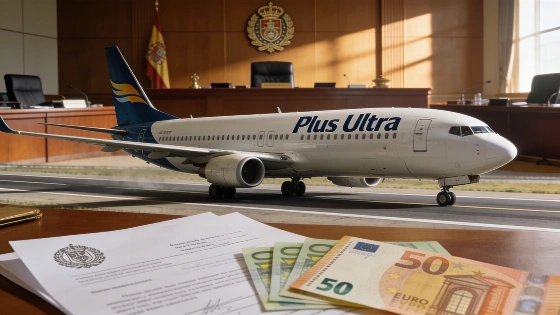
The PP has intensified its accusations against the government, alleging direct involvement of Sánchez and Zapatero in the €53 million Plus Ultra bailout. The case raises questions about political influence and possible legal consequences.
The Partido Popular (PP) has escalated its confrontation with the government, directly accusing Prime Minister Pedro Sánchez and former president José Luis Rodríguez Zapatero of facilitating the controversial €53 million rescue of the airline Plus Ultra. The opposition claims the executive may have committed influence peddling, a serious offense under Spanish law, in the process of granting public funds to the company during the pandemic.
On Tuesday, as Julio Martínez, administrator of Análisis Relevante, testified before Judge José Luis Calama at the Audiencia Nacional, the PP sharpened its rhetoric. Martínez reaffirmed his earlier written statement, pointing to Zapatero as the key figure behind the efforts to secure the bailout for Plus Ultra. However, he admitted under questioning that he could not confirm whether Zapatero had personally intervened with government officials to expedite the aid.
During a press conference in Congress, PP spokesperson Ester Muñoz accused Sánchez of being complicit in the alleged influence peddling. She argued that the rescue would not have occurred without a direct green light from the highest levels of government, stating that Zapatero either contacted a minister or Sánchez himself to push for the bailout. Muñoz also linked the operation to Delcy Rodríguez, then vice president of Venezuela, suggesting that Zapatero's connections in both Caracas and Madrid were decisive in the outcome.
PP leaders have been repeating this line for months, seeking to establish a direct link between the government and the controversial rescue. The party's strategy has gained momentum following the recent statements and court filings by Martínez, as well as by Plus Ultra executives Julio Martínez Sola and Roberto Roselli, both of whom are under investigation. Despite the lack of concrete evidence that government officials were directly lobbied, the PP insists that the available testimony and documents point to a coordinated effort at the top.
After Martínez's testimony, PP secretary Miguel Tellado reinforced the party's position on social media, claiming that the revelations had left Zapatero politically exposed and Sánchez under increasing pressure. Tellado argued that Sánchez's continued support for Zapatero, despite mounting allegations and judicial scrutiny, could only be explained by their shared interests in the matter.
Martínez also told the court that his business activities in Venezuela were made possible through Zapatero, who introduced him to Delcy Rodríguez. This connection, according to the PP, further illustrates the network of relationships that allegedly facilitated the Plus Ultra bailout. Muñoz maintained that Zapatero's ability to mediate between the Venezuelan and Spanish governments was only possible because of his ties to both Rodríguez and Sánchez, and she claimed that Zapatero personally profited from the operation.
The case has drawn significant attention in Spain, especially after previous revelations by Plus Ultra's leadership. For further background on the involvement of Zapatero in the airline's rescue, see this detailed report on the court filings and political implications: how Plus Ultra's president linked Zapatero to the bailout controversy.
Despite the PP's accusations, the investigation remains in the preliminary phase, and none of the key figures have provided definitive proof of direct government intervention. The party argues, however, that there are sufficient indications to warrant further scrutiny and has renewed its call for early elections.
Looking ahead, PP leader Alberto Núñez Feijóo is set to deliver his assessment of the political year at party headquarters, coinciding with the third anniversary of the July 2023 general elections. His speech is expected to intensify pressure on Sánchez, who will present his own review of the government's performance in the coming days, just before the final parliamentary session ahead of the summer recess.
Contextually, the Plus Ultra case has become a focal point in Spain's ongoing debate over the use of public funds during the pandemic and the boundaries of political influence. The controversy highlights the challenges of ensuring transparency and accountability in emergency economic measures. Spanish law treats influence peddling as a criminal offense, and any proven involvement by senior officials could have significant legal and political consequences. The outcome of the investigation may set important precedents for future government interventions in the private sector.