Vox joins the Andalusian government for the first time, securing a vice presidency and major ministries. The coalition with PP introduces new rules on public aid and marks a shift in regional power dynamics.
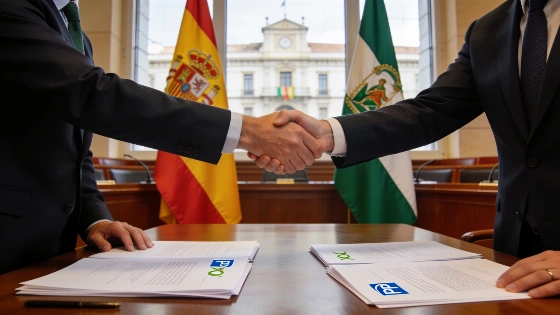
For the first time, Vox will hold seats in the Andalusian government, following a coalition agreement with the Partido Popular (PP) that reshapes the region’s political landscape. The deal, formalized just before Juan Manuel Moreno’s second investiture vote as president, grants Vox a vice presidency overseeing Tourism, Justice, Local Administration, and Deregulation—portfolios with significant influence in Andalusia’s economy and public services.
The agreement comes after weeks of negotiations, with PP needing two additional votes to secure a majority in the 109-seat regional parliament. Vox, led in Andalusia by Manuel Gavira, leveraged its 15 seats to demand not only entry into the executive but also control over strategic ministries. The coalition mirrors similar arrangements previously established by PP and Vox in Extremadura, Aragón, and Castilla y León, where Vox has also secured key government roles.
One of the most contentious points in the talks was the extent of Vox’s presence in the regional cabinet. While PP initially aimed to govern alone and limit Vox to technical ministries, the final agreement gives Vox a broad portfolio, though the distribution of other ministries remains undisclosed. Agriculture and Equality were particular sticking points, with PP resisting Vox’s push for these areas. Ultimately, the coalition reflects a compromise shaped by national party directives and the arithmetic of the Andalusian parliament.
A notable feature of the pact is the introduction of the “national priority” principle in the allocation of public aid, subsidies, and services. According to the agreement, access to these resources will prioritize individuals with a “real, lasting, and verifiable” connection to Andalusia. This echoes Vox’s longstanding electoral platform and aligns with similar measures in other regions where the party has entered government. The policy is expected to affect eligibility criteria for various forms of public support, potentially impacting immigrants and newcomers to the region.
Beyond the executive, Vox will also receive a vice presidency in the Andalusian parliament and one of the five Senate seats allocated to the region. The coalition marks the fifth such government in Andalusia since the first regional elections in 1982, following previous alliances between PSOE and the Partido Andalucista, PSOE and Izquierda Unida, and PP with Ciudadanos. The current deal replaces the previous PP-Ciudadanos coalition, which ended after the 2018 elections ousted the Socialists from power.
Moreno, who previously described the national priority policy as an “electoral slogan,” ultimately accepted the terms set by the PP’s national leadership. He justified the inclusion of Vox in the government by citing the need for stability and referencing past coalition experiences in Andalusia. The move has drawn criticism from left-wing parties, who refused to support a solo PP government and dismissed the coalition talks as mere political theater.
According to El País, the full text of the PP-Vox agreement is available for public review. The coalition’s formation signals a significant shift in Andalusian politics, embedding Vox’s influence in regional governance and setting a precedent for future power-sharing arrangements in Spain’s autonomous communities.
Andalusia, Spain’s most populous region, has long been a political bellwether. The entry of Vox into government reflects broader trends in Spanish politics, where coalition governments and new party alliances have become increasingly common since the end of the two-party system. The region’s economic reliance on tourism and agriculture makes the allocation of these ministries particularly consequential. As the new government takes shape, attention will focus on how the coalition manages policy differences and implements its agenda, especially regarding public aid and social services.