The Partido Popular is using the Ceuta crisis to challenge the government at the European level. Feijóo and his allies are pushing for tougher action, exposing sharp divisions over migration policy as pressure mounts on Sánchez.
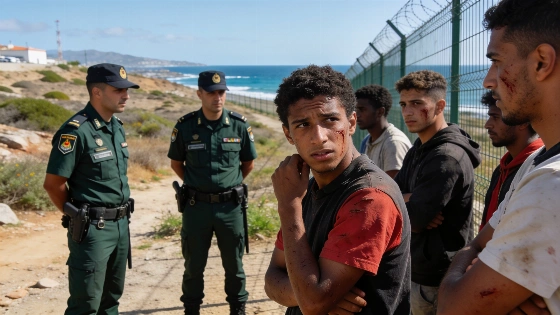
The Partido Popular has stepped up its campaign against Pedro Sánchez by bringing the Ceuta migrant crisis to the European stage. This week, PP leader Alberto Núñez Feijóo will visit Ceuta with Manfred Weber, head of the European People's Party. It will be Feijóo's fourth trip to the city since the mass border crossing a month and a half ago. Their visit is timed to draw attention in Brussels, as the European Parliament prepares to debate and vote on a resolution about Ceuta—a debate added to the agenda at the PP's request. According to European Parliament documents, the plenary debate is set for September 15, 2026, with a vote on September 17. The focus will be on Ceuta, hybrid attacks, and the need for a coordinated EU response to protect external borders.
The PP has turned the crisis into a political tool, both nationally and locally. Ceuta's long-serving president, Juan Jesús Vivas, has become a key figure in the party's campaign. His recent appearance on El Hormiguero was treated as a major local event, with business leaders funding a large outdoor screen and street celebrations to draw attention. The party's aim is to keep the spotlight on Sánchez's handling of the border emergency. According to Euronews, Vivas has also traveled to Brussels to meet with three European Commissioners and several MEPs, asking the EU for help with returning undocumented migrants and restoring normal life in Ceuta.
European Parliament
Recent CIS polling shows the political stakes. The PSOE's estimated vote share has dropped two points since July, now at 31 percent. The PP has gained four tenths, reaching 25.5 percent. Vox has seen the biggest jump, rising from 15.3 to 16.6 percent. Despite this, the PP continues to focus on damaging the Socialists, even as the far right benefits most from the crisis. Several Spanish media outlets and the latest CIS barometer confirm that Vox, not the PP, has gained the most ground.
The PP is now working to keep the crisis in the European spotlight. Feijóo's planned meeting in Madrid with Magnus Brunner, the EU's Commissioner for Interior and Migration, is part of this effort. Brunner, who has echoed PP talking points in the past, recently called Ceuta's border a "common EU frontier" and said that people without legal status must be returned to Morocco. The PP expects Brunner's statements and the upcoming European Parliament debate to support its position and increase pressure on the Spanish government. The ECR Group, representing European conservatives, has called for a tough response, with their Strasbourg agenda highlighting the need for investigation and action, and estimating that about 5,000 migrants remain in Ceuta.
EPRS (European Parliamentary Research Service)
At home, the PP is also active. On Tuesday, the party will present a motion in the Senate outlining its plan for Ceuta, covering security, migration, border management, relations with Morocco, economic measures, and the role of the Spanish state. The party's leaders have said they will not support relocating migrants from Ceuta to the mainland, even temporarily. "Morocco's social policy is not Spain's responsibility," PP spokesperson Borja Sémper said, repeating the party's refusal to accept transfers of migrants or minors. The PP says humanitarian aid and protection must come first, but that returns to Morocco are the only sustainable solution.
As the European Parliament prepares to debate the situation in Ceuta, the discussion will also cover the defense of EU external borders, the risk of hybrid attacks, and the role of Frontex. The PP is counting on a conservative shift in European migration policy to strengthen its position at home. The party's strategy is to keep the crisis alive in both Madrid and Brussels, using every institutional tool it can.
This approach has drawn criticism. As reported earlier, the PSOE has accused the PP of exploiting Ceuta's turmoil for electoral gain, while local authorities and residents are left in the middle. The standoff has stretched the city's resources and left its future uncertain, with no quick solution in sight.
The result is a calculated campaign by the PP to use Ceuta's crisis as evidence of government weakness, both for Spanish voters and European partners. By refusing to share the burden of migrant relocation and focusing on returns to Morocco, the PP is taking a harder line that matches the broader conservative shift in Europe. The party's willingness to use local hardship for political advantage may pay off at the polls, but leaves Ceuta's residents and migrants in limbo as the power struggle continues in Madrid and Brussels.