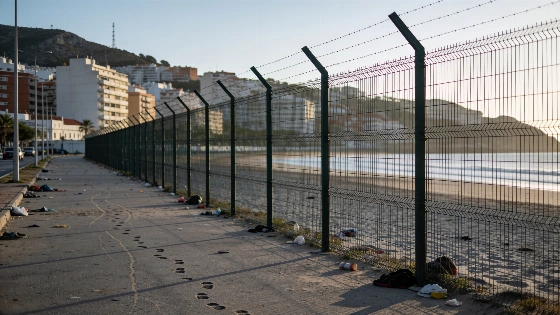
The PSOE leadership claims the PP is using Ceuta’s migrant crisis for electoral advantage. Government efforts to restore order face resistance from regional authorities. Tensions rise as thousands remain stranded in the city.
The political fight over Ceuta’s migrant crisis has intensified, with the PSOE accusing the PP of focusing on election strategy instead of practical solutions. The Socialists say the opposition is more interested in using the humanitarian emergency against Pedro Sánchez’s government than in resolving it.
The latest dispute centers on the planned visit of Alberto Núñez Feijóo and Manfred Weber to Ceuta. PSOE officials see this as a move to keep the crisis in the headlines. They argue the PP’s approach is meant to undermine government efforts and create political fallout, especially as the latest CIS poll shows the PSOE’s lead narrowing by two points. According to a recent European Parliament briefing, after a mass border crossing at the end of July 2026, about 70,000 to 80,000 people entered Ceuta, putting severe strain on the city and its accommodation system.
By September 9–11, Spanish authorities had prepared around 3,400 places for migrant accommodation in Ceuta, while 2,100 unaccompanied minors—including 700 girls—were registered in the city’s reception system.
Behind the scenes, the government is still dealing with thousands of irregular migrants in Ceuta. The PSOE claims the PP, both nationally and regionally, has blocked or delayed practical measures. One example is Ceuta’s president, Juan Jesús Vivas, who initially approved using the port for accommodation but later withdrew support after neighborhood protests. PP-led regions have also resisted taking in 500 unaccompanied migrant girls, while Navarra, governed by the Socialists, received the first group last week. Official statements say the transfer of minors has become a new point of conflict between the central government and several autonomous communities.
Montse Mínguez, speaking for the PSOE executive, criticized the PP’s stance, saying Ceuta’s well-being is being sacrificed for political theater. She argued the opposition’s real goal is to attack Pedro Sánchez, not to stabilize the city. Mínguez also pointed to emergency contracts awarded by the Ceuta government to relatives of trusted officials, as reported by eldiario.es, suggesting the crisis is being used for both political and financial gain. Meanwhile, Prime Minister Pedro Sánchez has said there is no convincing evidence that Morocco orchestrated the mass crossing, and that declassified documents released in early September do not support the idea of a premeditated crisis. Several international reports echo this, noting that while Spanish intelligence saw online campaigns encouraging crossings, these were not seen as signs of the scale of the influx that followed.
The PSOE leadership remains defiant, even as some in the party are uneasy about the government’s handling of the situation. Mínguez insisted the Socialists have come through past crises stronger, dismissing Feijóo’s repeated predictions of Sánchez’s political downfall. She also criticized the PP’s calls for snap elections, especially after the Supreme Court’s provisional suspension of voting rights for thousands of new Spanish citizens under the Ley de Memoria. The Central Electoral Board has complied with the court’s order, but the PSOE questions the legal and democratic basis for excluding these voters.
Ceuta’s president, Juan Jesús Vivas, has called on the EU for urgent assistance, demanding stronger border security and a plan for migrant returns. He has also accused Morocco of exerting political pressure on the city, while the EU is sending a technical mission to assess the situation, signaling that the crisis may soon become a broader European issue.
As the crisis enters its seventh week, the government has not set a timeline for restoring normality in Ceuta. The Socialists say only a unified state response can resolve the situation, while the PP continues to blame Sánchez’s leadership. The standoff has deepened divisions not only between the two main parties but also among Spain’s autonomous communities, with some regions refusing to share responsibility for migrant care.
Political maneuvering around Ceuta’s migrant influx is not new. As reported earlier, the crisis has already led to legal investigations and exposed rifts within the ruling coalition. The current escalation shows that, for now, political interests are taking priority over coordinated action, leaving Ceuta’s residents and migrants in ongoing uncertainty. The PSOE’s accusations against the PP reflect a broader pattern in Spanish politics: when crisis hits, parties often use it for electoral gain instead of working toward real solutions. Until both sides put the city’s stability ahead of partisan advantage, Ceuta’s path back to normality will remain blocked by political calculation.