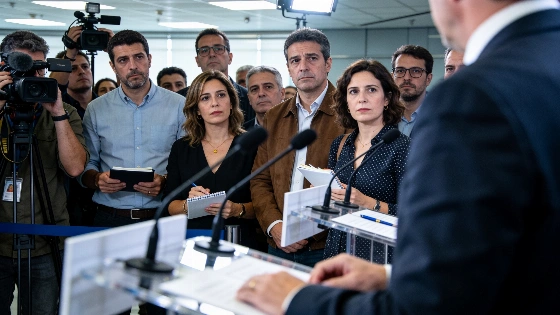
A leaked Interior Ministry dossier that classified journalists by political alignment has set off a wave of criticism in Spain. PSOE leaders and press associations are demanding an immediate end to the practice, while the Ministry faces growing calls to explain its actions.
Madrid is at the center of a political storm after it emerged that the Ministry of the Interior kept a dossier sorting dozens of journalists by their political leanings. First reported by El Confidencial, the document listed names, photos, and blunt labels such as "supports the Government," "aligned with right-wing positions," or "anti-sanchista." The reaction was swift. Reports say the dossier was completed in 2024 and arranged alphabetically, covering not just reporters but also editors, columnists, and leaders of journalist associations, according to Euronews and Democrata.
PSOE leaders quickly condemned the dossier, calling it an "authentic barbarity" and warning that such practices are both unacceptable and dangerous. Still, party officials avoided blaming Interior Minister Fernando Grande-Marlaska directly, describing the incident as "tremendous" but insisting he was not responsible for day-to-day operations. Ministry sources told Democrata the document was an "internal informational document" meant to help understand the media landscape, and that Grande-Marlaska neither ordered nor knew about it before it became public.
The dossier included not only journalists but also leaders and representatives of major professional associations such as APM, FAPE, and APP, which intensified the reaction within the media sector.
Journalist associations, including FAPE and the Asociación de Periodistas Parlamentarios (APP), issued strong statements demanding an immediate stop to any political profiling by the government. They warned that such actions undermine press freedom and public trust. Demócrata and El Nacional reported that these groups called the dossier an unacceptable form of ideological profiling that damages confidence in institutions.
Inside the Ministry, officials tried to play down the controversy, describing the dossier as an "internal informational document" and insisting that the Communication Office treats all journalists equally, regardless of their views. This explanation did little to calm critics or the opposition. The Ministry's position, cited by Euronews, was that the document was a working tool, not meant for discrimination, but this did not address the main concerns raised by the press and political opponents.
Patxi López, PSOE’s spokesperson in Congress, said that classifying people by ideology or opinion is fundamentally wrong. He called for the Ministry to explain itself but did not speculate further. Meanwhile, the Partido Popular seized on the scandal. Spokesperson Ester Muñoz accused Grande-Marlaska of ignoring major security lapses while keeping a "blacklist" of journalists, drawing comparisons to darker moments in Spain’s past. El Confidencial reported that the opposition is using the incident to demand accountability and highlight concerns about government transparency.
Published materials indicate that the controversy has moved beyond journalistic investigation and now centers on political and institutional responsibility. Further developments are expected to involve official inquiries and possible reviews of the Interior Ministry Communication Office's internal practices.
El Confidencial also reported that the dossier went beyond simple categorization, including subjective notes like "critical of the amnesty," "moderate," or "increasingly combative." This has raised questions about the purpose and possible use of such files. Many journalists now fear surveillance or retaliation, especially in an already polarized political climate.
Calls for accountability are growing, with both journalists and politicians demanding transparency and safeguards against future abuses. The episode has also revived memories of past internal conflicts within Spanish political parties, such as the recent withdrawal of Sara Oviedo from the PSOE mayoral race in Leganés, which exposed deep divisions and mistrust within party ranks.
Spain’s constitution protects press freedom and bans discrimination based on ideology. Any government action that appears to undermine these principles risks eroding public trust in democratic institutions. The Interior Ministry’s attempt to justify the dossier as routine internal work does not address the core issue: the state should not monitor journalists’ political positions. This episode highlights a disregard for boundaries that are essential in a democracy. If unchecked, such practices threaten both the independence of the press and the credibility of those in power.