A 1957 Messerschmitt, one of the world’s rarest bubble cars, stole the show at Pontevedra’s classic vehicle meet. Owner Manuel Abal brought it from Finland and plans a full restoration. The event also put a spotlight on unique Spanish motocarros.
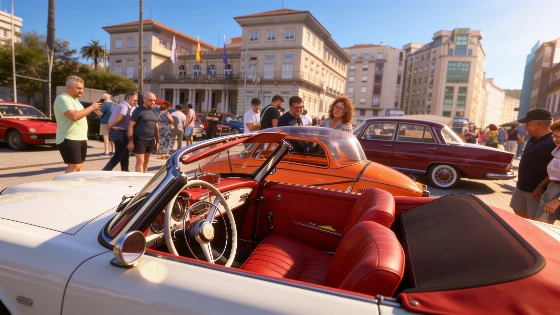
This weekend, people at Pontevedra’s Praza de España got a close look at a rare piece of car history: a 1957 Messerschmitt. Only 110 of these bubble cars are registered worldwide, and just one is known in Spain. Its bright orange paint and clear canopy made it stand out from the other classics, but what really drew attention was how hard it is to find and the story of how it got here.
Manuel Abal, who lives in Sanxenxo, spent years hunting for this car. He finally found it through a specialist website and brought it over from Finland. “I had a Beetle from 1963, which I sold to buy this car,” Abal said, standing next to the Messerschmitt and showing how its bubble dome opens. The car was blue when it left the factory, but now it’s orange. It runs on a small two-stroke engine with just ten horsepower—about the same as a Vespa scooter, as Abal pointed out.
According to local media reports, the Messerschmitt shown in Pontevedra arrived directly from Finland and remains unrestored, preserving its original condition from the 1950s.
Abal’s next step is to restore the car. He wants to bring it back to its original state before registering it for the road. He expects the restoration to cost at least 32,000 euros. The Messerschmitt’s three wheels, tandem seats, and roots in aircraft design—Messerschmitt started out making planes—make it a magnet for car fans and curious visitors. ClassicVirus notes that the KR200 model is a direct update of the earlier KR175, keeping the clear canopy and tandem seating that show off its aviation background.
The Messerschmitt wasn’t the only rare machine drawing attention at the eighth Concentración de Vehículos Clásicos e Antigos Cidade de Pontevedra. Not far away, Juan Gándara showed off his Isocarro, a blue three-wheeled motocarro from the 1950s, making its first public appearance. Gándara got the vehicle from the late Paco Outeda’s collection after years of waiting. “They knew I was interested and didn’t want it to be lost, so now it’s here,” he said. Faro de Vigo reported that both the Messerschmitt and Isocarro were highlighted ahead of the event as headline rarities among the roughly 70 classic vehicles expected.
The Isocarro has an Italian Iso engine and a simple design: motorcycle front, cargo bed at the back. It was once a workhorse for local delivery companies. Gándara’s Isocarro still shows signs of its working life and now stands as a tribute to the days when these vehicles handled most light deliveries. “They were the old Seur,” he joked, naming the well-known courier service. Gándara says only seven or eight similar vehicles are known in Spain, which makes his find even more special.
Independent reports confirm that the VIII Concentración de Vehículos Históricos in Pontevedra featured around 70 classic vehicles, with the Messerschmitt and Isocarro singled out as the main attractions. While the Messerschmitt is described as possibly the only one of its kind in Spain, this claim is based on owner statements and has not been officially verified in public registries.
This year’s event saw a late surge in turnout, with 74 vehicles filling the square. Club Ava organized the gathering, and city officials praised it for keeping local history alive and drawing in the public. “These vehicles are part of our history,” said Anabel Gulías, Pontevedra’s councillor for city promotion. She thanked the organizers and pointed to the strong response from the community.
Spain’s love for old cars goes beyond Pontevedra. As reported earlier, vintage rallies across the country keep attracting collectors and fans eager to see rare machines in action. Cars like the Messerschmitt and Isocarro at local events show that more people are starting to value the creativity and character of classic engineering.
What really stands out in Pontevedra is not just the rarity of the cars, but the owners’ drive to save and share these machines. They put in time, money, and effort to restore them, often with little hope of making that money back. This shows how much people value hands-on work and old-school craftsmanship. In a world full of mass-produced cars, the survival of unique models like the Messerschmitt and Isocarro gives a real link to a more inventive era. For Spain’s classic car scene, these stories are about more than nostalgia—they’re about keeping history alive, one restoration at a time.