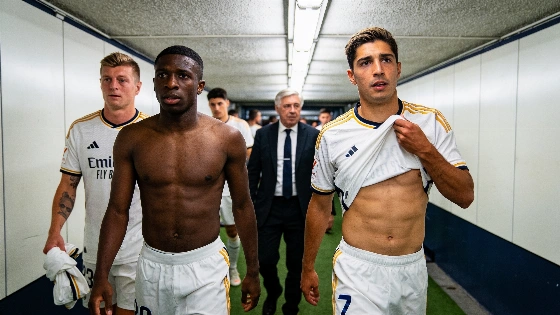
New footage from the Santiago Bernabéu tunnel captures Real Madrid’s Vinicius Jr., Kylian Mbappé, and Ibrahima Konaté pausing before putting on the “Todos somos caballas” shirts intended to show support for Ceuta. Filmed just before kickoff against Elche, the video captures the players’ uncertainty over a public gesture with political undertones.
Real Madrid and Elche players walked onto the pitch wearing shirts bearing the “Todos somos caballas” slogan, information from official club statements and reports from Reuters and BBC. Attention quickly shifted to the three Madrid players, who wore the shirts only partially and took them off immediately after greeting their opponents. Their actions sparked criticism and debate. Reuters reported that Real Madrid imposed no sanctions on Vinicius, Mbappé, or Konaté, leaving the decision to wear the solidarity shirt to the players.
Inside the tunnel, Real Madrid coach José Mourinho noticed Elche’s players already wearing the shirts as his own team hesitated. Mourinho began to ask, “So... about the shirt...?”, but trailed off. Team captain Federico Valverde put on a shirt and urged his teammates to follow. Mbappé first signaled for the kitman to wait. After Valverde insisted, he and Vinicius reluctantly pulled the shirts over their chests, barely showing the slogan.
Meanwhile, referee Jesús Gil Manzano and Elche goalkeeper Matías Dituro exchanged a few words. Dituro questioned the meaning of the gesture, and the referee replied, “Matías, let’s not start complicating comparisons.” Dituro responded, “No, but if we’re coming out like this, it’s to show support,” and the referee answered, “Tell that to people with a child there,” pointing to the emotional weight of the situation.
After the match, Mbappé said he did not oppose the people of Ceuta but wanted to show empathy for everyone suffering, including people beyond one group. He said he hoped to send a message of peace and called for a swift resolution to the crisis. BBC and other outlets reported that Mbappé publicly expressed solidarity with Ceuta and its victims while also voicing support for migrants facing hardship.
Press reports said business leaders in the Valencia region, not La Liga, initiated the solidarity shirts and coordinated the campaign in advance. La Liga president Javier Tebas later criticized the players, saying that wearing the shirt only partially was equivalent to refusing it. He also clarified that the league was not behind the gesture.
The incident has renewed debate about the overlap of football, politics, and public gestures in Spain. Symbolic clothing on the pitch is nothing new, but the reluctance of well-known players to take part fully has sparked fresh discussion about athletes’ role in political statements. As seen in other recent Spanish news, such as the Bilbao street exhibition, public symbols and collective memory remain hotly debated in Spain.
The Real Madrid episode shows how gestures intended to unite can become flashpoints when players face institutional pressure and personal beliefs. The tunnel video shows the decision being made on the spot, amid pressure and visible discomfort. In today’s climate, every action on the field is closely watched for its wider meaning, and the line between sport and society keeps getting thinner. In Spanish football, symbolic acts risk causing more division than unity when players do not genuinely agree with them.