Spain’s regions have backed €25 million in emergency aid for Ceuta. However, sharp disagreements persist over relocating unaccompanied migrant minors. The government faces resistance from key autonomous communities.
Spain’s autonomous communities have unanimously endorsed the transfer of €25 million in state funds to Ceuta to address the surge of unaccompanied migrant minors, but the political standoff over their redistribution remains unresolved. The decision, confirmed at Thursday’s Sectoral Conference on Childhood and Adolescence, comes nearly a month after hundreds of minors entered the city in late July, overwhelming local resources and sparking urgent calls for support.
While the financial aid was approved without dissent, the debate over relocating minors from Ceuta to other regions exposed deep divisions. The Ministry of Youth and Children, led by Sira Rego, reiterated that family reunification is the preferred solution for these children. However, Rego acknowledged that in most cases, returning minors to their families is not feasible, leaving Spanish authorities responsible for their care and integration.
Efforts to transfer minors out of Ceuta have stalled, with several regions—particularly those governed by coalitions including Vox—refusing to accept any children. Aragón, Extremadura, and Castilla y León, where Vox holds authority over child welfare, boycotted the meeting and formally rejected any redistribution from Ceuta. Their stance follows earlier tensions, including Vox’s withdrawal from regional governments after the Partido Popular agreed to accept minors from the Canary Islands.
Currently, the Ministry estimates that 1,500 minors are in Ceuta’s care system, though NGOs on the ground suggest the real number could be twice as high. The €25 million package is intended to cover accommodation, food, legal support, medical care, and other essential services for the minors, as well as to prevent them from ending up on the streets. The funds will also support the identification and protection of vulnerable children.
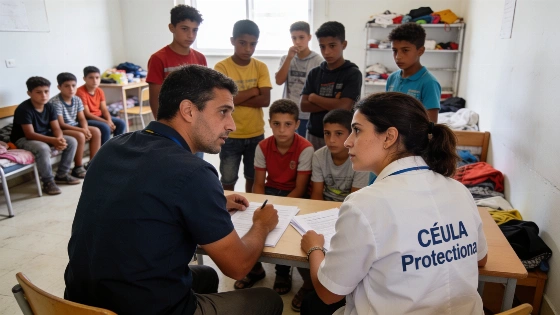
Despite criticism over the speed of the government’s response, Rego defended the process, citing the need for approval from both the Council of Ministers and the Sectoral Conference. She explained that the current phase focuses on verifying the identities of the minors, with individual interviews to follow. Once these steps are complete, cases will be referred to Moroccan authorities to assess family situations, though cooperation from Morocco remains limited. According to Rego, 600 cases sent to Morocco before July 30 are still awaiting a response.
During the meeting, the Ministry proposed relocating 500 minors from Ceuta to private facilities on the mainland, managed by child protection organizations. However, Ceuta would retain legal guardianship. The city’s government has yet to decide on this proposal. Meanwhile, Madrid’s regional minister Ana Dávila rejected any redistribution and called for the minors’ return to their families, also arguing that the €25 million is insufficient to cover more than two months of care. The Canary Islands echoed this concern, warning that the funding would not last beyond three months based on their own experience.
Catalonia’s representative, Raúl Moreno, declined to specify whether the region would accept any minors, citing existing pressure on its own child protection system, which currently supports over 2,000 minors and more than 4,000 young adults aged 18 to 23. He stated that Catalonia would review any proposals but insisted that the response cannot fall on a single region.
Spain’s approach to managing unaccompanied migrant minors has become a flashpoint between the central government and regional authorities, reflecting broader tensions over migration policy and resource allocation. The situation in Ceuta is particularly acute, with local infrastructure stretched to its limits. The government’s plan to use private facilities on the mainland is seen as a temporary measure, but the lack of consensus among regions complicates any long-term solution.
For context, recent government actions in other areas—such as the rollout of climate shelters in Madrid—have also faced scrutiny over their effectiveness and reach, as highlighted in a recent report on Madrid’s climate shelters. The ongoing debate over migrant minors in Ceuta underscores the challenges Spain faces in coordinating regional and national responses to urgent social issues.
Spain’s legal framework assigns responsibility for unaccompanied minors to the region where they are found, but exceptional surges like the one in Ceuta have prompted calls for a more flexible, coordinated approach. The outcome of this dispute will likely shape future policy on migration and child protection across the country.