A nationwide Renfe strike threatens 322 trains and 27% of AVE and Long-Distance services. The Ministry imposes minimum service levels to protect travel at the start of Spain’s summer holidays.
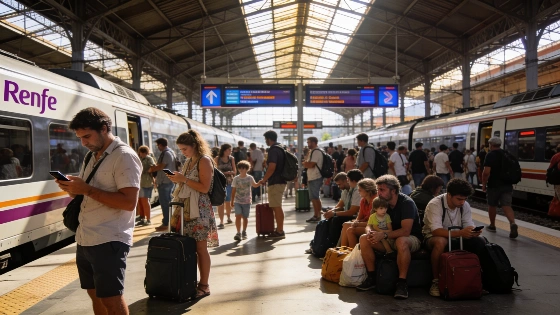
Spain’s summer holiday rush faces a major setback this Friday, 31 July, as a strike called by the Sindicato Ferroviario puts hundreds of Renfe trains in jeopardy. The Ministry of Transport and Sustainable Mobility has intervened, setting strict minimum service requirements to balance the right to strike with the urgent need for mobility at the peak of the travel season. According to the ministry’s resolution, 322 trains across the country are not guaranteed to run, and 27% of AVE and Long-Distance services could be suspended, with key routes linking Andalusian capitals to the rest of Spain particularly exposed.
For AVE and Long-Distance trains, the government has mandated a 73% minimum service. Out of 343 scheduled trains affected by the strike, 251 will operate, leaving 92 high-speed services uncertain. This measure aims to ensure that the backbone of Spain’s rail network remains functional, especially as thousands prepare to leave for their holidays. The ministry’s approach is based on a modal analysis, weighing the capacity of rail against alternatives like air and intercity bus travel.
Medium-Distance services are also under pressure. Here, the minimum service is set at 65%, meaning 432 out of 662 trains will run, while up to 230 could be suspended depending on strike participation. The impact will be felt most on high-demand routes, such as the Avant high-speed line connecting Málaga, Córdoba, and Sevilla, which typically carries nearly 3,000 passengers on a working day. Conventional lines like Sevilla–Cádiz, with over 4,200 daily users, are also at risk of disruption.
The government’s calculations highlight the limits of alternative transport. Medium-Distance trains on busy lines offer around 240 seats and run at 80% occupancy, while buses on the same routes can only absorb a fraction of displaced passengers due to lower capacity and current occupancy rates. As a safeguard, Renfe is required to maintain at least one train per direction per day on all Medium-Distance routes, ensuring essential travel for work, healthcare, or administrative needs is not completely cut off.
Commuter rail (Cercanías) services, vital for daily workers, will operate at 75% of normal levels during peak hours and 50% at other times. In major urban areas with high-frequency lines, the rules guarantee a train every 20 minutes per direction during rush hour, but never more than half the usual service outside those periods. This is intended to keep critical urban mobility intact for hospital visits, work shifts, and other non-deferrable activities.
The Sindicato Ferroviario, which represents Renfe’s intervention and driving staff nationwide, has called the strike over what it describes as a “dangerous situation” on board, citing repeated failures in air conditioning systems—a problem made worse by Spain’s intense summer heat. Previous strikes by the same union in recent weeks saw minimal participation, with less than 2.1% of staff joining the action.
Renfe stresses that the absence of minimum service protection does not automatically mean a train will be cancelled; actual disruptions will depend on how many workers join the strike. To manage uncertainty, Renfe has activated its contingency protocol, contacting affected passengers to offer rebooking on the nearest available train or, if preferred, free changes or cancellations through all standard sales channels.
Rail disruptions are not new to Spain’s transport landscape. Earlier this year, a major cable theft in Catalonia forced the complete suspension of the R3 Rodalies line, leaving thousands stranded and highlighting the vulnerability of the country’s rail infrastructure. For more on how such incidents have previously impacted Spanish rail travel, see this report on recent rail chaos in Catalonia.
Spain’s rail network is a critical artery for both daily commuters and long-distance travelers, especially during the summer exodus. The government’s intervention with minimum service levels reflects the challenge of balancing workers’ rights with the country’s dependence on efficient transport. While buses and planes offer alternatives, their limited capacity means that any large-scale rail disruption can quickly ripple through the broader mobility system. The outcome of Friday’s strike will depend on participation rates, but the measures in place aim to prevent a complete standstill at one of the busiest times of the year.