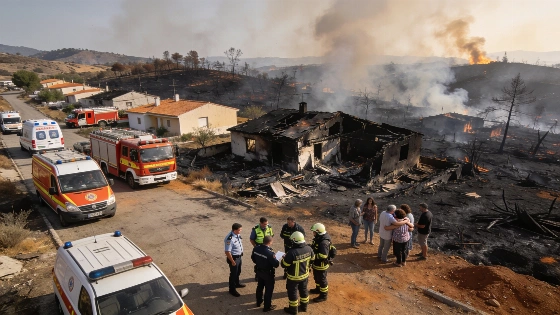
A major wildfire has left dozens of homes destroyed in El Encinar del Alberche. Residents say they feel abandoned by the mayor, while local authorities point to national emergency protocols. The dispute highlights gaps in crisis response.
Discontent is mounting in El Encinar del Alberche, a large residential community in Villa del Prado, after a devastating wildfire destroyed 43 homes and damaged nearly 300 more. Hundreds of residents, represented by community president Emilia López, have voiced frustration over what they describe as a lack of support and communication from their mayor, Belén Rodríguez, during and after the emergency.
The fire, which began in Almorox (Toledo), quickly spread into the urbanization, forcing evacuations and leaving many families unable to return to their properties. López, who leads the community of 1,700 plots—most of them built—said the crisis exposed a longstanding sense among residents that their needs are overlooked by local authorities except when convenient. She emphasized that, despite the scale of the disaster, municipal involvement was minimal, with residents themselves coordinating initial alerts, evacuations, and even care for pets left behind.
According to López, the only direct assistance from the town hall was a generator for water pumping, which proved unusable. Residents ultimately had to rent their own equipment to address urgent needs. She also noted that communication from the mayor’s office was sporadic and largely reactive, with updates and offers of help coming only after repeated requests from the community. Many affected families remain uncertain about when or how they will be able to return home, and some are still without basic utilities.
Mayor Belén Rodríguez, however, maintains that she has been in regular contact with López and other residents. She points out that the emergency response is now under the control of the national government due to the severity of the situation, and that other areas of Villa del Prado have also suffered significant damage from the fires. Rodríguez explained that most residents evacuated to Madrid, while around 300 people have been housed in the municipal sports center since Wednesday. She stressed that decisions about reentry and recovery are being made by higher authorities, and that her own staff are stretched thin by multiple fires across the municipality.
Despite these explanations, López insists that the local administration’s presence and support have been insufficient. She has called for an urgent meeting involving the town hall, emergency services, and relevant agencies to clarify next steps for affected residents. The mayor has agreed to meet with her in person at the municipal offices.
The situation in El Encinar del Alberche reflects broader challenges faced by Spanish communities during wildfire emergencies. As seen in other recent incidents, such as the mass evacuations and disruptions reported in central Spain (see coverage of regional evacuations and emergency sheltering), coordination between local, regional, and national authorities can become strained under pressure. In Villa del Prado, the debate over responsibility and communication underscores the importance of clear protocols and visible support for residents during crises.
Wildfires have become an increasingly frequent threat in Spain, particularly in rural and peri-urban areas where housing developments border forested land. The country’s emergency response system typically involves a combination of local services, regional firefighting units, and national agencies, with command shifting depending on the scale of the incident. For affected communities, timely information and practical assistance remain critical concerns as they navigate the aftermath and begin recovery efforts.