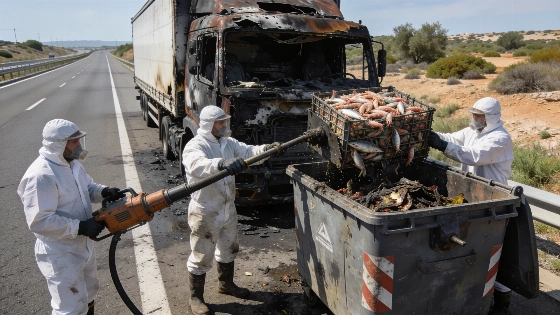
A burned-out truck carrying 25 tons of octopus sat for nearly a month on the A-381, leaving drivers to deal with the smell and raising questions about insurance and public safety.
After nearly a month of complaints and a smell that seeped into every passing car, the truck loaded with rotting octopus was finally removed from the A-381 near Alcalá de los Gazules. The cleanup, which started Tuesday, ended weeks of frustration for drivers stuck with the consequences of a legal and insurance standoff.
The trouble began on August 20, when a seafood truck caught fire at kilometer 61 of the Jerez-Los Barrios route. Firefighters from Los Barrios responded as flames took over both the truck and its 25-ton load of octopus, spreading to nearby grass and brush. According to La Voz del Sur and Diario de Cádiz, seven firefighters and four engines were needed to put out the fire.
Despite repeated demands from the Junta de Andalucía, the truck and its decomposing cargo remained on the roadside for nearly a month due to a legal and insurance impasse between the Moroccan owner and insurer.
Once the fire was out, the real problem started. Instead of a quick cleanup, the burned truck and its cargo were left behind a barrier. For almost four weeks, commuters and locals complained about the overwhelming smell and the obvious health risk. Social media picked up the story, and Canal Sur Radio journalist Jesús Vigorra publicly questioned how long authorities would let the situation drag on.
Sorting out who was responsible turned into a legal mess. The truck belonged to a private owner from Morocco, and both the owner and insurer—also Moroccan—refused to pay for the cleanup, citing policy limits. The Junta de Andalucía, which manages the highway, kept warning the parties and demanding action, but nothing happened. Only after weeks of inaction did the owner finally hire Perezoca, a waste removal company from Algeciras, to deal with the biological hazard. La Voz del Sur confirmed that the cleanup was started by a private contractor, not the authorities, after a long delay.
Perezoca’s crew worked in short shifts to remove the spoiled octopus and packaging, trying to avoid new traffic problems. The company estimated they would need at least one full waste container—up to 30 cubic meters—to haul away the decomposing seafood. They coordinated with the Dirección General de Tráfico to keep the busy freight route, which connects to the Port of Algeciras, as open as possible during the work.
Independent Spanish media emphasized that the prolonged presence of the spoiled cargo posed not only a nuisance but also a potential health hazard, with strong odors and sanitary risks reported by both drivers and local residents.
— Diario de Cádiz
The truck itself, now just a burned shell, stayed on the roadside until Wednesday, since Perezoca was only hired to remove the biological waste. Spanish traffic law requires the driver or their insurer to clear vehicles and cargo after an accident as soon as possible. If they don’t, authorities can step in and bill whoever is responsible. In this case, the cross-border ownership and insurance made enforcement difficult, leaving the public to deal with the fallout.
Other Spanish regions have faced similar problems with slow emergency response and tangled logistics, as seen in earlier incidents involving delayed equipment recalls and bureaucracy.
This episode highlights a major gap in Spain’s system for handling hazardous transport incidents, especially when foreign-registered vehicles and insurers are involved. The month-long delay was more than an inconvenience—it was a public health risk and a test of how well institutions can respond. Until these legal and procedural gaps are closed, Spanish roads remain exposed to similar problems, with real costs for public health and trust in the system.