A wildfire in Huesca forced the urgent removal of Aragón’s medieval royal remains from San Juan de la Peña. Authorities transferred the bones and key artifacts to the Huesca Archaeological Museum for protection.
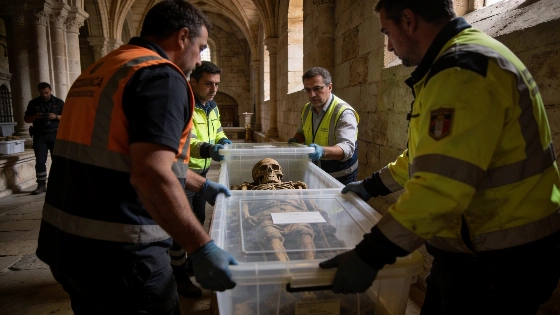
Emergency teams in Huesca have carried out a rare and urgent evacuation of the royal tombs from the historic monastery of San Juan de la Peña. As wildfires advanced dangerously close to the site, the remains of Aragón’s medieval monarchs—Ramiro I, Sancho Ramírez, Pedro I—and their families were removed from their centuries-old resting place. The operation, led by the Unidad Militar de Emergencias (UME), Guardia Civil, and Aragón’s cultural heritage specialists, was completed on Thursday afternoon as flames threatened the Romanesque complex.
The royal bones, originally discovered by archaeologists between 1984 and 1986 beneath 11 lead caskets in the monastery’s caves, were carefully placed in plastic urns for transport. Some containers left the bones partially visible, underscoring the urgency of the rescue. Alongside the remains, authorities also secured paintings, jewelry, and replicas of the Santo Grial, which, according to Aragonese tradition, was kept at San Juan de la Peña for 350 years. All items are now stored in the reserve area of the Huesca Archaeological Museum, away from public view.
According to José Ignacio Lorenzo Lizalde, the archaeologist who led the original excavations, Aragón stands out as the only European kingdom to preserve the physical remains of its royal family from the 10th and 11th centuries. The bones’ exceptional state of preservation is attributed to the unique conditions of the Royal Pantheon, which acted as a natural refrigerator. Regional authorities have stated that the remains will be returned to the monastery as soon as conditions allow.
The government of Aragón described the intervention as swift and exemplary, with the UME and Guardia Civil working under the direction of cultural heritage officials. For now, the focus remains on extinguishing the wildfire, and no further updates on the royal remains are expected until the emergency is over. The entire monument complex is closed to visitors until further notice, and refunds are being issued for online ticket purchases. Access roads to the area have also been shut due to the fire risk.
Mar Vaquero, vice president and regional minister for Presidency, Justice, Culture, and Sport, acknowledged that the hours between 13:00 and 17:00 on Thursday were particularly tense. The monastery’s construction beneath solid rock helped slow the fire’s progress, preventing greater damage to the heritage assets. Although the immediate threat has lessened, authorities remain cautious, emphasizing that safeguarding the royal remains is now a top priority.
This incident follows a pattern of cultural heritage sites in Spain facing wildfire threats in recent years. As highlighted in a related report, emergency evacuations of historic relics have become increasingly common as wildfires intensify. The situation in Huesca underscores the vulnerability of Spain’s most treasured monuments to climate-driven disasters.
San Juan de la Peña is one of Aragón’s most significant historical sites, known for its unique architecture and its role as a royal burial ground. The preservation of these remains is not only a matter of regional pride but also of European historical importance. The current crisis highlights the ongoing challenge of protecting irreplaceable heritage from natural disasters, a concern that is likely to grow as extreme weather events become more frequent across Spain and southern Europe.