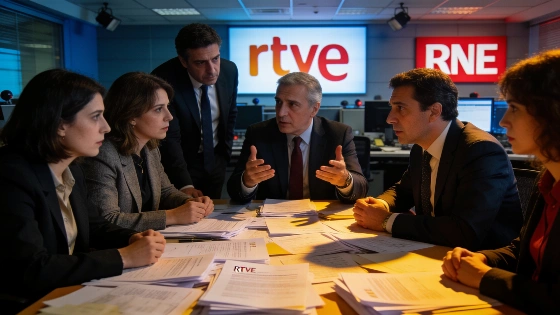
RTVE has launched disciplinary action against seven members of RNE's News Council. The case, tied to accusations of serious misconduct, could lead to suspensions or dismissals. The move has triggered unprecedented tension inside Spain's public radio.
Spain's public broadcaster RTVE has initiated disciplinary proceedings against seven out of nine members of the Consejo de Informativos de RNE, marking an extraordinary escalation in internal tensions at Radio Nacional de España. The management, acting through its HR department and the corporation's Ethics Channel, accuses these council members of 'very serious' offenses that could result in anything from suspension without pay to outright dismissal. Several employees described the development to EL MUNDO as a 'tsunami' within the organization, underscoring the shockwaves it has sent through the newsroom.
The disciplinary action follows a complaint by an RNE employee, R.M., who alleged psychological mistreatment and workplace harassment by several council members. This complaint came after two resolutions issued by the Consejo de Informativos in early 2026, both critical of the editorial practices of the program 24 Horas. The council had previously adopted similar resolutions, but these two specifically targeted 24 Horas, citing concerns over 'malpractice' and repeated errors by the program's director.
In response to the complaint, RTVE activated its official harassment protocol, commissioning an external psychological assessment. According to sources familiar with the process, the external report confirmed the existence of harassment, though the accused council members were not shown the evaluation. The council later reported that several of its members suffered severe anxiety crises, leading to medical leave, and argued that the damage inflicted was a direct result of fulfilling their legal duties.
On June 18, the RTVE Psychological Harassment Commission voted on whether to advance the case based on the external psychologist's findings. The commission's internal rules require a minimum number of votes from both management and staff representatives to proceed. While UGT and SI supported continuing the process, CCOO opposed, citing insufficient evidence of sustained harassment, and USO abstained, arguing the protocol had not been properly followed. The lack of consensus meant the commission could not formally recommend a resolution, but the process was not automatically closed.
Despite the absence of a binding recommendation, RTVE management pressed forward, opening individual disciplinary files against the seven council members. The council denounced this move as an attempt to undermine their legally mandated editorial oversight, insisting that their actions were protected by law and that the harassment process lacked legal foundation. They also pointed to Article 47.c of the RTVE Information Statute, which explicitly protects council members from dismissal or sanction for actions taken in the course of their duties.
Shortly after the commission's inconclusive vote, the accused members received official notifications from RTVE's Occupational Risk Prevention and Health Area, stating only that no resolution had been proposed regarding the alleged harassment. The council interpreted this as confirmation that no harassment had occurred and demanded the immediate closure of the case. Nevertheless, the HR department and Ethics Channel have kept the disciplinary process open, basing their actions on the external psychological report and citing 'very serious offenses,' 'psychosocial impact,' and 'serious breach of good faith.'
This internal conflict at RTVE comes at a time when editorial independence and the role of oversight bodies are under scrutiny across Spain's media landscape. The case echoes broader debates about the boundaries of internal accountability and the protection of journalistic autonomy. For context, similar tensions over editorial control and internal investigations have surfaced in other Spanish institutions, as seen when the government declined to dismiss the Guardia Civil chief amid an internal probe, a situation detailed in this related report.
RTVE's disciplinary action against the Consejo de Informativos de RNE is unprecedented since the creation of these oversight bodies. The outcome could set a significant precedent for how Spain's public broadcasters handle internal disputes and the legal protections afforded to those tasked with safeguarding editorial standards. The case also highlights the complex interplay between internal governance, legal frameworks, and the pressures facing public media in Spain.
For reference, the Consejo de Informativos was established to ensure editorial independence and compliance with Spain's broadcasting laws. Its members are elected by newsroom staff and are charged with monitoring content and upholding journalistic standards. The current dispute raises questions about the limits of their authority and the mechanisms available to resolve conflicts between management and editorial oversight bodies within public institutions.