Pedro Sánchez faces sharp criticism in Congress after a confidential police report links Morocco to the Ceuta migrant influx. Coalition partners and opposition demand explanations, leaving the government’s version of events under fire.
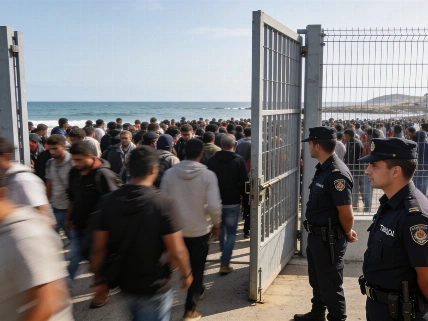
A confidential police report sent to the Audiencia Nacional has put the government’s defense under pressure: the document points to Moroccan involvement in the mass entry of 72,000 migrants into Ceuta. This comes just as Pedro Sánchez prepares to address Congress, where even members of his own coalition are questioning the official account.
The timing is difficult for Sánchez. The report contradicts the government’s repeated efforts to clear Rabat of responsibility, leaving the president politically isolated. The opposition—PP and Vox—are demanding answers, but so are key allies like Sumar, IU, ERC, EHBildu, PNV, Junts, and Podemos, who now reject the claim that Morocco had no role. The government’s attempt to shield Rabat has collapsed under new evidence and growing dissent within its own ranks.
According to recent official figures, nearly 70,000 of those who crossed into Ceuta during the July surge were returned to Morocco in the following days.
Sumar has accused Morocco of "responsibility by action or omission," while IU calls the involvement "evident" and "criminal," demanding a stronger diplomatic response. ERC and EHBildu have dismissed the government’s position as "ridiculous," insisting Morocco is the "elephant in the room." Junts and Podemos go further, questioning what leverage Rabat holds over the Spanish government and calling its stance "incomprehensible" and "submissive."
The criticism is not just rhetorical. Alberto Ibáñez of Compromís-Sumar has called for transparency, data, and clear answers from Sánchez. The PNV warns that Spain must set boundaries with Rabat, while EHBildu describes the incident as a "new generation hybrid attack." The backlash is now so broad that even the government’s usual partners are distancing themselves from its narrative.
The main controversy is not proven Moroccan guilt, but a conflict of interpretations around a confidential police report. While some Spanish media claim the CENIF document points to Moroccan security forces' involvement, the Interior Ministry publicly denies that the report attributes planning or execution of the events to Morocco.
Sánchez also faces criticism over the government’s handling of the Ceuta incident. Opponents point to a slow response, the president’s vacation timing, and the lack of a clear plan for the migrants who entered. The right calls for expulsions; the left wants transfers to the peninsula. The government is caught between demands it cannot reconcile, with no agreement in sight.
The government’s narrative has unraveled quickly. In less than two days, the police report has forced a reckoning not just with the opposition, but within the ruling coalition. As reported earlier, the rift has deepened as law enforcement bypassed the Interior Ministry to deliver evidence directly to the courts, exposing divisions at the top of the executive.
The government’s insistence on Morocco’s innocence now looks unsustainable. Previous incidents, like the 2021 border crisis, have already shown that Rabat uses migration as leverage. The current police findings reinforce suspicions that Morocco can control its borders when it chooses. The rush to absolve Rabat, despite growing documentation and the situation on the ground, has left Sánchez politically exposed and his credibility in doubt.
Spain’s handling of the Ceuta crisis now highlights political isolation. When a government is contradicted by its own police, abandoned by partners, and openly challenged in parliament, the cost is more than reputational. It signals a breakdown in institutional coherence and a willingness to prioritize diplomatic convenience over transparency. Refusing to address Morocco’s role, even as evidence mounts, is less a strategy than a retreat. Sánchez’s effort to control the narrative has only deepened the crisis and left his government more vulnerable.