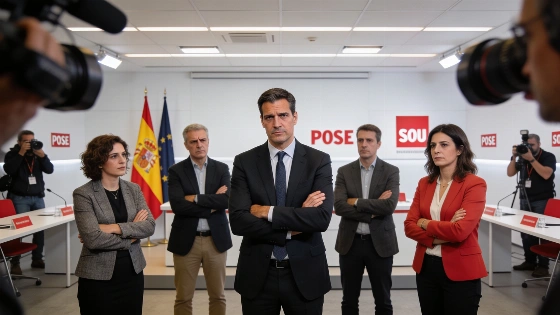
Pedro Sánchez is under renewed pressure regarding the roles of Santos Cerdán and Ábalos in PSOE. Recent revelations have intensified debate about their continued presence in party leadership and electoral lists.
Pedro Sánchez, as both Prime Minister and secretary general of PSOE, is facing renewed scrutiny over his decisions to maintain key figures Santos Cerdán and Ábalos in prominent party roles. The debate intensified after recent discussions on laSexta Xplica, where journalist Gabriel Sanz questioned why Sánchez, despite apparent prior knowledge, included Ábalos in the 2023 general election lists and kept Santos Cerdán as secretary general during the 41st Federal Congress in Seville.
During the program, Sanz expressed skepticism that Sánchez was unaware of the issues surrounding these party members, suggesting that the leadership's choices may have deeper implications for PSOE's internal dynamics. Miguel Ángel Campos, a journalist specializing in judicial affairs at Cadena Ser, noted that, according to a UCO report, Santos Cerdán led a notably modest lifestyle and was careful not to attract attention. This observation was echoed by presenter José Yélamo, who pointed out that the restaurant most frequented by Cerdán—visited 49 times—was not a luxury venue but rather a mid-priced establishment. Yélamo emphasized that while the facts remain serious, Cerdán appeared to be discreet in his habits.
The controversy comes at a time when the party is already under pressure from ongoing investigations. The Guardia Civil's UCO recently reported difficulties in tracing the origins of suspected secret funds linked to PSOE, prompting calls for a comprehensive audit of party accounts. For more on the financial scrutiny facing PSOE, see the latest developments as the Guardia Civil seeks a full audit of party transactions in this related report.
These developments highlight the growing tension within PSOE regarding transparency and accountability. The continued presence of figures like Santos Cerdán and Ábalos in leadership positions has sparked debate about the party's direction and the standards expected of its senior members. As the investigation progresses, the outcome may influence not only internal party politics but also public trust in PSOE's governance. The situation underscores the broader challenges facing Spanish political parties in maintaining credibility amid ongoing judicial and media scrutiny.
For context, PSOE (Spanish Socialist Workers' Party) is one of Spain's major political forces, with a long history of governance and opposition. The party's internal decisions, especially regarding leadership and candidate selection, often have significant implications for national politics. Recent years have seen increased attention to issues of transparency and ethical conduct within Spanish parties, reflecting broader societal demands for accountability in public life.