Pedro Sánchez showed up in Gavá for a PSOE event with an eleven-vehicle escort. While he focused on party politics, Ceuta was still in chaos, with thousands of migrants stuck in limbo.
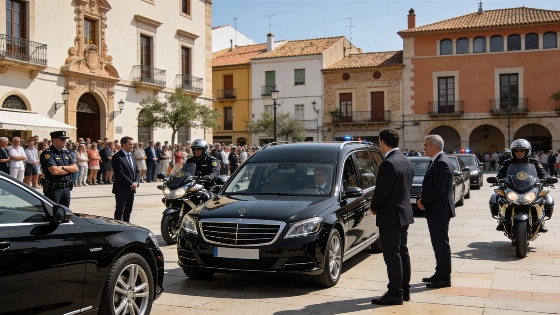
Pedro Sánchez made his presence known before he even spoke in Gavá. The Prime Minister pulled up to the Fiesta de la Rosa, a major PSOE event in Barcelona province, with a convoy of nine cars and two motorcycles. The motorcade was hard to miss, especially for a party event far from Madrid.
OKDIARIO published images showing the full scale of the operation. Sánchez arrived around midday. Salvador Illa, president of the Generalitat, and Gemma Badia, mayor of Gavá, were there to greet him. The security and logistics echoed what happened days earlier in San Juan del Puerto, Huelva, where Sánchez toured with ten vehicles. Several independent Spanish media outlets confirmed Sánchez's appearance at the Fiesta de la Rosa with Salvador Illa and Gemma Badia, showing how important the event was for both PSOE and PSC.
Multiple sources noted that the Gavá event was widely interpreted as the symbolic launch of the new political season for PSOE and PSC in Catalonia, rather than just a local party gathering.
On stage, Sánchez went after Partido Popular and Vox, with sharp words for Isabel Díaz Ayuso. He only mentioned Ceuta briefly, accusing the opposition of wanting “the photo of the crisis” instead of real answers. Meanwhile, Ceuta saw another big protest. Marchers headed to the El Tarajal border, chanting against Sánchez’s government. Independent reports confirm that Sánchez's speech in Gavá focused on attacking PP and Vox, pushing for socialist mobilization and support for Catalonia, as several national outlets reported.
Sánchez’s timing in Gavá stood out. Fifty days after the migrant surge in Ceuta, the crisis is still not resolved. Moncloa says Ceuta is now the government’s top priority. Still, about 10,000 irregular migrants remain in the city, and 3,000 are without shelter in camps. Sánchez is now set to travel to New York to present Spain’s migration response at the United Nations General Assembly. He plans to defend his government’s handling of the crisis and the intelligence failures that left authorities unprepared for the arrival of roughly 80,000 people. However, independent sources have not confirmed the exact figures of 10,000 irregular migrants or 3,000 without accommodation; these numbers should be checked against official data from Moncloa or international organizations.
The split between Sánchez’s political campaigning at home and the ongoing emergency in Ceuta is clear. As a recent analysis points out, Spain’s politics are now shaped by spectacle and confrontation, often leaving real solutions behind.
On the same day as Sánchez's appearance in Gavá, opposition leaders Feijóo and Abascal also held political events in Catalonia, reinforcing the perception among Spanish media that this Sunday marked the informal start of the pre-election campaign in the region. The convergence of major parties in Catalonia was widely covered as a sign of heightened political mobilization ahead of the upcoming electoral cycle.
Sánchez’s focus on big appearances and heavy security may boost his standing inside the party, but it does little to ease the pressure from unresolved crises. The government keeps saying Ceuta is a priority, but thousands are still stuck there, and the Prime Minister’s attention is already shifting abroad. In the end, the show of power can’t replace real action. The gap between political theater and what’s actually happening on the ground keeps getting wider.