Nicolás Sartorius, a key figure of Spain's democratic transition, warns that the current political climate is more polarized than ever. He criticizes the Popular Party's adoption of far-right positions and highlights the risks for Spanish democracy.
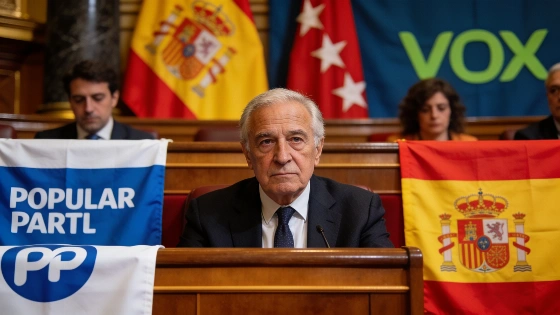
Spain's political landscape is facing a period of heightened tension, with veteran leftist Nicolás Sartorius raising alarms about the direction of the country's main conservative party. Sartorius, who played a central role in Spain's transition to democracy and spent years imprisoned under Franco, argues that the Popular Party (PP) is moving away from its traditional centrist roots by embracing policies associated with the far-right Vox party.
According to Sartorius, the adoption of 'national priority' and other identity-based policies by the PP marks a significant break from the principles of citizenship that have underpinned Spanish democracy since the late 1970s. He warns that this shift echoes patterns seen in authoritarian and xenophobic regimes, where identity takes precedence over equal rights for all citizens. Sartorius points to recent legislative moves and rhetoric that, in his view, undermine the social and political consensus built during the country's democratic transition.
He also highlights the unprecedented level of hostility directed at the current government led by Pedro Sánchez. Sartorius claims that no administration since the restoration of democracy has faced such sustained attacks and insults, both in parliament and across media platforms. He attributes part of this escalation to the influence of social networks and the amplification of political polarization online.
On the issue of governance, Sartorius defends the current legislature's record, citing progress in Catalonia, economic growth, and falling unemployment. He dismisses calls for early elections as a tactic by the right and insists that the absence of new budgets does not justify dissolving parliament, referencing previous governments that operated under extended budgets without crisis.
Sartorius is critical of the PP's reluctance to present a motion of no confidence, suggesting that the party lacks a coherent alternative program and is unwilling to bridge the gap between its own positions and those of Vox or regional parties. He also rejects the narrative that Spain is inherently corrupt, emphasizing the country's effective management of European funds and the constitutional principle of presumption of innocence.
Discussing the judiciary, Sartorius acknowledges that while not all judges are politically motivated, there are sectors within the state apparatus determined to oppose the current government's social and economic policies. He cites recent high-profile investigations and legal actions as evidence of a broader campaign to destabilize the executive, particularly targeting figures close to the prime minister.
On immigration, Sartorius notes that regularizations have been carried out by both left and right governments, and argues that opposition to such measures often masks a desire to maintain a vulnerable, rightless workforce. He criticizes those who blame immigrants for strains on public services, pointing out that younger migrant populations typically use health and education services less than the native population.
Reflecting on the evolution of the PP, Sartorius asserts that the party no longer represents the centrist, consensus-driven tradition of the democratic transition. Instead, he sees it as reverting to the more hardline stance of its predecessor, Alianza Popular. He warns that if the PP were to govern in coalition with Vox, it would threaten the foundations of Spain's welfare state and regional autonomy.
In the broader context, Sartorius draws parallels between current trends in Spain and the rise of radical right movements elsewhere in Europe. He stresses the importance of unity among left-wing parties and the need for a minimum common program to counter the growing influence of identity politics and protect the achievements of the democratic era.
Spain's political system, established after the end of Franco's dictatorship, was built on broad agreements between parties of different ideologies. The current polarization and the blurring of lines between mainstream and far-right positions represent a significant challenge to that legacy. As Spain continues to grapple with questions of identity, governance, and social cohesion, the debate over the future direction of its major parties remains at the center of national attention.
For context, Spain's transition to democracy in the late 1970s was marked by a commitment to consensus and the integration of diverse political forces. The Popular Party, originally founded as Alianza Popular, gradually moved toward the center during the 1990s and 2000s. However, the emergence of Vox and the pressures of recent political crises have led to renewed debates over the boundaries of acceptable political discourse and the resilience of Spain's democratic institutions. The outcome of these debates will likely shape the country's political and social landscape for years to come.